Tokyo is not one city but a dozen cities sharing a rail map — and that is exactly what makes it the perfect subject for AI travel video. In a single day you can stand in the middle of the busiest pedestrian crossing on earth, look up at a glowing orange tower, picnic under pink cherry blossom, and walk through a temple founded in the year 645. The contrast is the story: neon against old wood, crowds against calm, the future against the seventh century. These Tokyo AI video prompts turn those real places into ready-to-render travel videos, even if you have never ridden the Yamanote Line.
Below you will find four detailed, copy-paste-ready prompts. Each one is built around a real place in Tokyo — the Shibuya Scramble Crossing, Tokyo Tower at night, Ueno Park in cherry-blossom season and Senso-ji temple in Asakusa — with camera directions, lighting notes and a matching image idea so your video feels like a real travel film, not a slideshow.
Table of Contents
- 1. Shibuya Scramble Crossing at Night
- 2. Tokyo Tower and the Shinjuku Skyline at Night
- 3. Ueno Park in Cherry Blossom Season
- 4. Senso-ji Temple in Asakusa
- Tips for Better Tokyo AI Video Prompts
- Watch: Tokyo in Motion
- Frequently Asked Questions
- Conclusion
1. Shibuya Scramble Crossing at Night
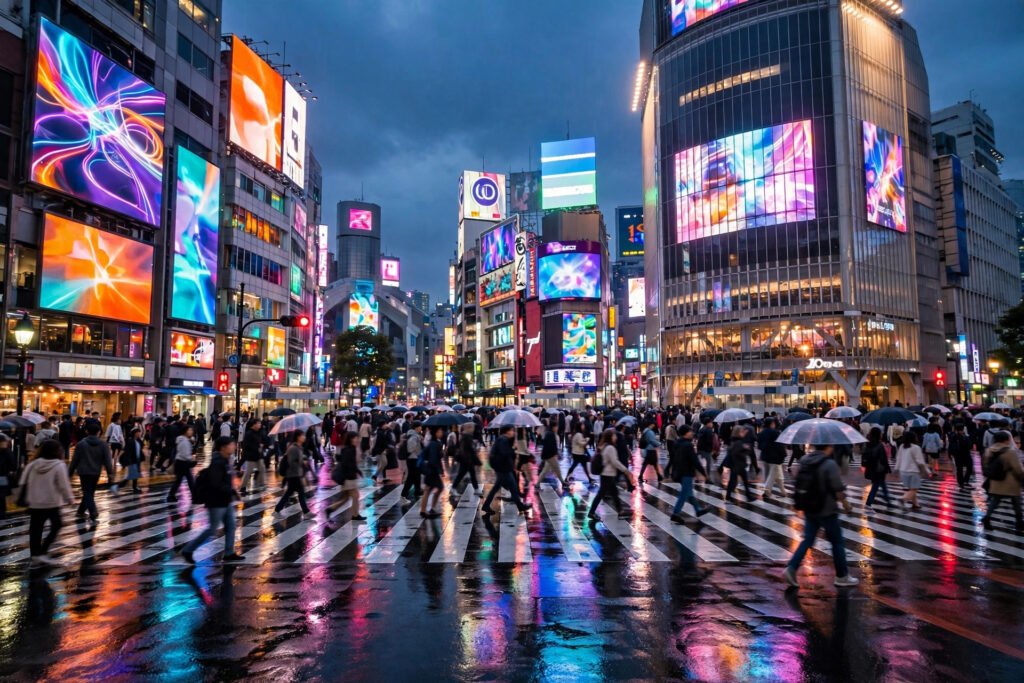
The Shibuya Scramble Crossing is the most filmed intersection in the world — thousands of people crossing from every direction at once when the lights turn green, under giant screens and neon billboards. It is the image most people picture when they think of Tokyo, and it is pure energy on camera. The best view is from above, where the crowd becomes a flowing pattern, or from street level, where the neon washes over everything. Saturday night at 8 pm is the absolute peak, when the crossing is at its most chaotic.
Copy-paste prompt:
Cinematic video of the Shibuya Scramble Crossing in Tokyo, Japan at night. Thousands of pedestrians crossing the famous scramble intersection in all directions, giant neon billboards and glowing video screens on the buildings above, wet pavement reflecting the neon light in pink, blue and gold. Camera starts high above the crossing looking down at the flowing crowd, then descends slowly to street level as the lights change and the crowd surges forward. Electric, energetic, photorealistic travel film, 4K, no text, no watermark.
Image-prompt idea: A high-angle night photograph of the Shibuya Scramble Crossing, crowds of people crossing in all directions like flowing rivers, bright neon signs and giant video screens glowing around the square.

Why it works: A crowd seen from above becomes a pattern, and patterns are very forgiving in AI video — individual faces blur into movement, which is exactly what you want. The descending camera move gives the clip a natural arc, from the famous overview down into the energy of the street. Wet pavement is a bonus: the neon reflections double the colour and hide small imperfections in the ground.
Real-world detail worth knowing: the crossing is free and open 24 hours, and the best viewpoint is the Shibuya Sky observation deck, about 229 metres up, which costs around ¥2,000 and needs a reservation. The official Tokyo tourism site has the latest Shibuya area guides, deck tickets and neighbourhood maps.
2. Tokyo Tower and the Shinjuku Skyline at Night
Tokyo Tower is the city’s classic landmark — a red-and-white lattice tower inspired by the Eiffel Tower, glowing warm orange against the night sky. It stands in the middle of the modern skyline, surrounded by the glass towers of Shinjuku, and the contrast between the old tower and the new city is the shot. At night the tower is lit up, the office windows sparkle, and the whole city looks like a circuit board. It is the calm, glowing counterpoint to Shibuya’s chaos.
Copy-paste prompt:
Cinematic video of Tokyo Tower in Tokyo, Japan illuminated in warm orange light at night, glowing against a deep blue evening sky, modern Shinjuku skyscrapers with lit windows rising around it, city lights sparkling far below. Camera starts wide on the tower and the skyline, then moves slowly forward and tilts up along the tower’s lattice structure toward the glowing antenna. Warm orange against cool blue, elegant and cinematic, photorealistic travel film, 4K, no text, no watermark.
Image-prompt idea: A photograph of Tokyo Tower illuminated in warm orange light at night, glowing against a deep blue evening sky with modern Shinjuku skyscrapers and city lights around it.

Why it works: A single tall subject with a clean silhouette is one of the easiest things for AI video to render well, and the warm-orange-against-deep-blue palette is instantly cinematic. The slow forward move with a gentle tilt up is a single, simple camera direction, so the tower stays stable in the frame while the skyline slides past. Night scenes also hide small texture errors in the dark.
For more Japan inspiration, see our Kyoto AI video prompts — the same old-meets-new contrast works beautifully for Japan’s ancient capital.
3. Ueno Park in Cherry Blossom Season
Ueno Park is Tokyo’s most famous hanami ground — more than a thousand cherry trees lining wide avenues, turning the whole park pink in late March and early April. Families spread blue mats under the blossom, petals drift through the air like snow, and the park’s museums, zoo and temples sit quietly behind the pink haze. It is the softest, most romantic scene in this set, and the one that makes a Tokyo video feel complete: after the neon and the towers, the city exhales.
Copy-paste prompt:
Cinematic video of Ueno Park in Tokyo, Japan in full cherry blossom season. Pink sakura trees line a wide walking path, petals drifting gently through the air, families enjoying hanami picnics on blue mats under the blossoms, soft spring sunlight filtering through the pink canopy. Camera glides slowly forward along the blossom-lined path as petals fall, then tilts gently up into the canopy of pink flowers. Soft, dreamy, romantic spring light, photorealistic travel film, 4K, no text, no watermark.
Image-prompt idea: A photograph of Ueno Park in full cherry blossom season, pink sakura trees lining a wide path with petals drifting in the air and people enjoying hanami picnics under the blossoms.

Why it works: Falling petals give the scene built-in motion, so even a slow camera glide feels alive. The soft pink palette is also very forgiving — blossom does not need sharp geometry to look real. Keep the people small and at a distance, sitting or walking, so the blossom canopy carries the shot instead of the crowd.
Planning a wider Japan trip? Our Mount Fuji AI video prompts cover Japan’s most famous mountain in every season, including cherry-blossom spring.
4. Senso-ji Temple in Asakusa
Senso-ji, founded in the year 645, is Tokyo’s oldest temple, and it sits in Asakusa — the old “low city” of Edo-era lanes, market stalls and low rooftops. You approach through the Kaminarimon gate, under its giant red lantern, then walk the Nakamise shopping street, lined with stalls selling snacks and souvenirs, to the main hall and its five-storey pagoda. The temple grounds are free and open day and night, and the calmest hour is just after dawn, before the crowds arrive.
Copy-paste prompt:
Cinematic video of Senso-ji Temple in Asakusa, Tokyo, Japan in warm late afternoon light. The giant red Kaminarimon lantern hangs at the entrance gate, the five-storey pagoda and the main temple hall rising behind it, the Nakamise shopping street with traditional wooden stalls leading toward the temple. A few visitors walk slowly along the street as incense smoke curls in the air. Camera tracks forward slowly down Nakamise toward the temple gate, then tilts up to the pagoda. Warm, historic, peaceful atmosphere, photorealistic travel film, 4K, no text, no watermark.
Image-prompt idea: A photograph of Senso-ji Temple in Asakusa, the giant red Kaminarimon lantern at the entrance gate with the five-storey pagoda and main hall behind it, traditional stalls along the Nakamise street.

Why it works: A straight walk down a single street is the simplest camera move an AI generator can do well — one direction, one speed, no turns — and the temple at the end gives the shot a clear destination. The red lantern and pagoda are bold, simple shapes that render cleanly, and the warm afternoon light flatters the old wood. It is the perfect closing scene: old Tokyo, calm after the neon.
Tips for Better Tokyo AI Video Prompts
- Let the contrast carry the film. Neon Shibuya, glowing Tokyo Tower, pink Ueno Park, red-and-gold Senso-ji — the four prompts above move from electric to elegant to soft to historic. That arc is what makes a four-scene video feel like a journey, not a slideshow.
- One camera move per prompt. Descend, tilt up, glide forward or track forward — pick one. Two moves in one prompt is the most common reason AI videos warp or jump.
- Keep crowds at a distance. Tokyo’s crowds are the story, but AI faces are the weakness. Shoot from above, from behind, or with people small in the frame, and the crowd reads as energy instead of errors.
- Add real sound. Pair the visuals with city ambience — crossing signals and footsteps for Shibuya, soft piano for the tower at night, birdsong and gentle chatter for the park, and temple bells for Asakusa.
- Check your facts. Senso-ji was founded in 645 and is Tokyo’s oldest temple, the Shibuya crossing is free and open around the clock, the cherry blossom peaks in late March to early April, and Tokyo Tower’s main deck costs around ¥1,500. Getting these names and numbers right in your video captions builds trust with viewers who have actually been there. Senso-ji’s official site confirms the temple’s history and opening hours.
Watch: Tokyo in Motion
Before you render your own clips, watch how a real travel video frames the city — Shibuya at its Saturday-night peak, the Scramble Crossing from every angle and the neon chaos of Center Gai. It is the best reference for pacing your AI-generated version.
Frequently Asked Questions
What are Tokyo AI video prompts?
Tokyo AI video prompts are ready-made text instructions you paste into an AI video generator to create cinematic travel clips of Tokyo — the Shibuya Scramble Crossing, Tokyo Tower at night, Ueno Park cherry blossom and Senso-ji temple — without filming there yourself.
Which AI video tools work best with these prompts?
Any modern text-to-video tool that supports cinematic camera moves works well. Tools with a dedicated “cinematic” or “travel film” style preset handle the neon night scenes and the slow glides in these prompts most reliably.
How long should each Tokyo AI video clip be?
Five to ten seconds per clip is ideal. Generate the four scenes separately, then stitch them together in an editor like CapCut with a hard cut and a music track. Short clips also keep crowds, towers and temple roofs from distorting.
Can I use these Tokyo videos for YouTube Shorts and Instagram Reels?
Yes. Render in vertical 9:16 for Shorts and Reels, or 16:9 for a full YouTube travel video. The prompts above work in either format — just set the aspect ratio in your generator before rendering.
What is the best time of year to show in a Tokyo video?
Late March to early April for cherry blossom, or November for crisp air and autumn colours. Avoid the hot, humid rainy season in June and early July unless the rain is part of the story.
Is Senso-ji temple free to visit?
Yes — the temple grounds are free and the main hall is open from around 6 am to 5 pm. The Nakamise shopping street in front of it is one of the oldest shopping streets in Japan. The official Senso-ji site has the full history and visiting details.
Why do my Tokyo AI videos look warped sometimes?
Usually the prompt asks for too much at once — two camera moves, a dense crowd at close range, and a complex skyline in the same clip. Simplify to one subject and one slow camera move, keep crowds small or distant, and the geometry stays stable.
Conclusion
Tokyo earns its reputation in about ten seconds of footage: a crossing that swallows thousands of people at once, a tower glowing orange over a sea of lights, pink petals falling on a park path, and a temple that has stood since the year 645. With these four Tokyo AI video prompts — Shibuya at night, Tokyo Tower and the skyline, Ueno Park in cherry blossom and Senso-ji in Asakusa — you can build a complete travel film that feels like a real trip across the world’s biggest city. Render one scene at a time, keep the camera moves slow and simple, and let the city’s own contrast do the heavy lifting. Your next viral travel reel might just start with a crossing.
Planning more Japan videos? Our cherry blossom spring park AI video prompts cover the sakura season beyond Tokyo, and Wikipedia’s Tokyo page is a solid fact-check for the city’s districts, history and landmarks.
Pingback: New York AI Video Prompts: 4 Cinematic Prompts for Times Square, Central Park & More