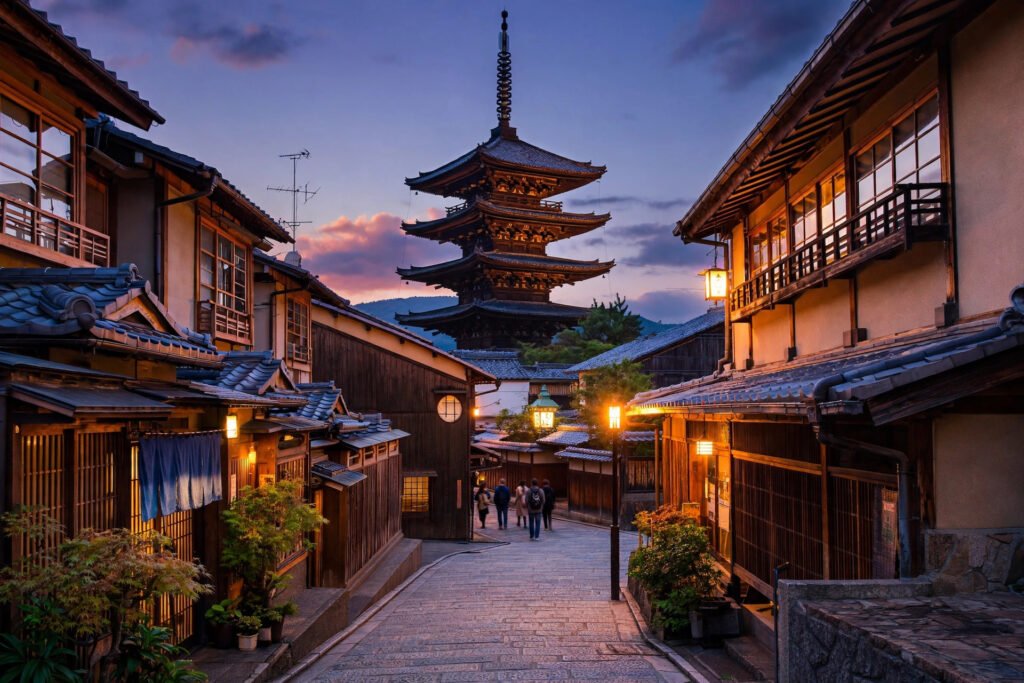
Kyoto is the Japan that lives in everyone’s imagination. Towering green bamboo, ten thousand vermilion torii gates climbing a mountain, a wooden temple stage floating above maple trees, and lantern-lit lanes where a maiko might hurry past in the dusk. It was the imperial capital of Japan for more than a thousand years, and it still holds around 1,600 Buddhist temples and 400 Shinto shrines — more cinematic locations per square kilometre than almost anywhere else on earth. These Kyoto AI video prompts turn those real places into ready-to-render travel videos, even if you have never set foot in Japan.
Below you will find four detailed, copy-paste-ready prompts. Each one is built around a real place in Kyoto — the Arashiyama bamboo grove, the torii-gate tunnels of Fushimi Inari, the wooden stage of Kiyomizu-dera and the lantern-lit streets of Gion — with camera directions, lighting notes and a matching image idea so your video feels like a real travel film, not a slideshow.
Table of Contents
- 1. Morning Light in the Arashiyama Bamboo Grove
- 2. Walking the Vermilion Torii Gates of Fushimi Inari
- 3. Golden Hour at Kiyomizu-dera Temple
- 4. Gion Streets at Dusk
- Tips for Better Kyoto AI Videos
- Watch: Kyoto in Motion
- Frequently Asked Questions
- Conclusion
1. Morning Light in the Arashiyama Bamboo Grove
The Arashiyama bamboo grove, in Kyoto’s western hills, is one of the most photographed paths in Japan. Tall green bamboo stalks lean over a stone walkway, filtering the morning sun into soft shafts of light, and the sound of the bamboo swaying in the wind is so famous that Japan’s Ministry of the Environment listed it among the country’s 100 Soundscapes. Arrive early in your video, just as you should in real life — before 8 a.m. the path is almost empty, and the light does all the work.
Copy-paste prompt:
Cinematic video of the Arashiyama bamboo grove in Kyoto, Japan, in soft early morning light. Towering green bamboo stalks lean over a narrow stone path as gentle sunbeams filter down through the canopy. A lone visitor in a light kimono walks slowly away from the camera along the path, leaves rustle in a soft breeze, and the bamboo sways almost imperceptibly. Slow forward tracking shot along the path, then a gentle tilt up into the bamboo canopy. Serene, photorealistic travel film, fresh green tones, 4K, no text, no watermark.
Image-prompt idea: A morning photograph of the Arashiyama bamboo grove, a stone path winding between towering green bamboo with soft sunbeams filtering through the canopy and a lone walker in the distance.

Why it works: Vertical lines and a single straight path are the easiest geometry for an AI video generator to hold stable, so the bamboo rarely warps. The slow tracking shot gives the scene movement without asking the generator to do anything complicated, and the soft morning light hides small imperfections far better than harsh midday sun. Keep the people count low — one walker is enough.
For more Japan inspiration, see our Mount Fuji AI video prompts — the same soft morning light works beautifully around Japan’s most famous mountain.
2. Walking the Vermilion Torii Gates of Fushimi Inari
Fushimi Inari Taisha, founded in 711, is the head shrine of some 30,000 Inari shrines across Japan — and its mountain trails are lined with around 10,000 vermilion torii gates. The Senbon Torii, the “thousand torii gates”, forms a glowing red tunnel that every Kyoto travel video needs. The trick is to film the tunnel, not the crowd: in your prompt, ask for early morning and a single walker, and the gates become a corridor of pure colour.
Copy-paste prompt:
Cinematic video walking through the Senbon Torii tunnel at Fushimi Inari Taisha in Kyoto, Japan, in warm early morning light. Hundreds of vermilion-red torii gates form a glowing tunnel over a stone path climbing the forested mountainside, sunlight flickering between the gates, stone fox statues standing quietly at the sides. A slow, steady forward walk through the tunnel, the gates passing on both sides, then a gentle rise to reveal the path continuing uphill. Rich red and deep green tones, photorealistic travel film, 4K, no text, no watermark.
Image-prompt idea: A photograph inside the Fushimi Inari torii tunnel, hundreds of vermilion gates receding uphill with warm light glowing between them and a lone visitor walking away.

Why it works: The repeating gate pattern is a gift for AI video — the generator only has to repeat one simple shape, so the tunnel stays consistent as the camera moves. The steady forward walk is the most reliable camera move there is. If the render looks too busy, drop the fox statues and the walker and let the gates carry the shot on their own.
Real-world detail worth knowing: the shrine grounds are open around the clock and entry is free, and the full hike to the summit of Mount Inari takes two to three hours. The shrine’s own site at Fushimi Inari Taisha confirms the grounds, the history and the etiquette visitors are asked to follow.
3. Golden Hour at Kiyomizu-dera Temple
Kiyomizu-dera, the “Pure Water Temple”, has stood on the slopes of Mount Otowa since 778. Its great wooden stage, built without a single nail and held up by tall timber pillars, juts out over a valley of maple trees — and at golden hour, with the city of Kyoto glowing below, it is the single most cinematic temple view in the city. In spring the maples are fresh green; in late November they turn a fierce red. Either way, this is your video’s money shot.
Copy-paste prompt:
Cinematic video of Kiyomizu-dera temple in Kyoto, Japan, at golden hour. The famous wooden stage on tall timber pillars juts out from a forested hillside, the three-storey pagoda stands beside it, and maple trees in warm autumn colour fill the valley below while the city of Kyoto glows hazy in the distance. Slow aerial drift from the side of the stage, then a gentle push-in toward the temple’s curved wooden roof as the evening light turns gold. Warm, majestic, photorealistic travel film, 4K, no text, no watermark.
Image-prompt idea: A golden-hour photograph of Kiyomizu-dera’s wooden stage on its timber pillars, maple trees in autumn colour below and Kyoto glowing in the hazy distance.

Why it works: One strong subject, one slow camera move, and warm directional light — that is the formula that keeps AI architecture stable. The side-on drift shows off the stage’s dramatic pillars without asking the generator to rotate around a complex building, which is where renders usually break. Mention the season in your prompt: “autumn maples” or “fresh green spring maples” gives the scene a clear, consistent palette.
Planning the real trip around this shot? The temple’s official site at Kiyomizu-dera lists opening hours and seasonal events, and our Japanese tea garden AI video prompts show how the same temple-garden palette works in a quieter setting.
4. Gion Streets at Dusk
Gion is Kyoto’s famous geiko district, a preserved neighbourhood of wooden machiya townhouses, ochaya tea houses and narrow stone lanes around Hanamikoji Street. At dusk the paper lanterns come on, the crowds thin out, and the streets turn the deep blue of early evening against warm golden windows. It is the quiet, atmospheric ending your Kyoto video needs after the colour of Fushimi Inari and the grandeur of Kiyomizu-dera — and it is also the scene that most rewards a slow, patient camera.
Copy-paste prompt:
Cinematic video of Gion district in Kyoto, Japan, at dusk. A narrow lantern-lit stone lane lined with traditional wooden machiya townhouses and tea houses, warm paper lanterns glowing in the windows, a maiko in a colourful kimono walking slowly away down the lane. Deep blue evening sky above the dark tiled roofs, soft reflections on the stone pavement. Slow forward dolly down the lane, then a gentle tilt up to the lanterns and rooflines. Atmospheric, photorealistic travel film, warm gold against deep blue, 4K, no text, no watermark.
Image-prompt idea: A dusk photograph of a lantern-lit Gion lane, wooden machiya townhouses with glowing paper lanterns and a maiko in a colourful kimono walking away under a deep blue sky.

Why it works: Low light and a single light source — the lanterns — hide AI imperfections better than any daylight scene, and the narrow lane keeps the camera move simple and linear. One distant figure is enough; asking for faces or a crowd in the dark is where renders go wrong. The blue-and-gold palette also matches the dusk light of the featured image, so the whole video feels like one evening.
If you like the quiet-evening mood, our cherry blossom spring park AI video prompts use the same soft light and slow dolly for a very different season.
Tips for Better Kyoto AI Videos
- Shoot early morning and dusk first. Kyoto’s most famous places are crowded by mid-morning, and your prompts should say so: “early morning, few people” for Arashiyama and Fushimi Inari, “dusk” for Gion. The light is better then, and so are the renders.
- One camera move per prompt. Tracking shot, slow dolly, gentle push-in or aerial drift — pick one. Two moves in one prompt is the most common reason AI videos warp or jump.
- Keep the palette consistent. Vermilion red, fresh bamboo green, warm wood and deep dusk blue appear across all four prompts above. Repeating those colours across your clips makes a multi-scene video feel like one film.
- Add real sound. Pair the visuals with soft koto or shamisen music, temple bells, or the rustle of bamboo. Kyoto’s official travel guide at Kyoto Travel has area-by-area information that helps you match the right sound and season to each location.
- Check your facts. Fushimi Inari was founded in 711, Kiyomizu-dera in 778, and the bamboo grove’s soundscape is officially recognised in Japan. Getting these details right in your video captions builds trust with viewers who have actually been there. The Kyoto Travel guide is a solid fact-check for areas, transport and the best months to visit.
Watch: Kyoto in Motion
Before you render your own clips, watch how a real travel video frames the city — Fushimi Inari, the bamboo grove, the temples and the evening streets in sequence. It is the best reference for pacing your AI-generated version.
Frequently Asked Questions
What are Kyoto AI video prompts? Kyoto AI video prompts are ready-made text instructions you paste into an AI video generator to create cinematic travel clips of Kyoto — the Arashiyama bamboo grove, the Fushimi Inari torii gates, Kiyomizu-dera temple and the Gion district — without filming there yourself.
Which AI video tools work best with these prompts? Any modern text-to-video tool that supports cinematic camera moves works well. Tools with a dedicated “cinematic” or “travel film” style preset handle the golden-hour lighting, the bamboo canopy and the slow dolly moves in these prompts most reliably.
How long should each Kyoto AI video clip be? Five to ten seconds per clip is ideal. Generate the four scenes separately, then stitch them together in an editor like CapCut with a hard cut and a music track. Short clips also keep faces and temple architecture from distorting.
Can I use these Kyoto videos for YouTube Shorts and Instagram Reels? Yes. Render in vertical 9:16 for Shorts and Reels, or 16:9 for a full YouTube travel video. The prompts above work in either format — just set the aspect ratio in your generator before rendering.
What is the best time of year to show in a Kyoto video? Late March to early April for cherry blossom season, and mid-November to early December for the red maple season around Kiyomizu-dera. Both are peak crowd seasons in real life, which is exactly why generating them with AI is so appealing — your video gets the season without the queues.
Do I need to credit anything when I use AI-generated Kyoto footage? No credit is required for the AI visuals themselves, but label the video as AI-generated if your platform asks for it, and do not present the clips as real footage you filmed in Kyoto.
Why do my Kyoto AI videos look warped sometimes? Usually the prompt asks for too much at once — two camera moves, a crowd, and a complex temple in the same clip. Simplify to one subject and one slow camera move, and the geometry stays stable.
Conclusion
Kyoto earns its reputation in about ten seconds of footage: a bamboo path in morning light, a tunnel of red gates, a wooden stage floating above the maples, a lantern glowing in a dark lane. With these four Kyoto AI video prompts — Arashiyama in the morning, Fushimi Inari’s torii gates, Kiyomizu-dera at golden hour and Gion at dusk — you can build a complete travel film that feels like a real trip to Japan’s old capital. Render one scene at a time, keep the camera moves slow and simple, and let the city’s own colours do the heavy lifting. Your next viral travel reel might just start in a bamboo grove.
Planning more Japan videos? Our Mount Fuji AI video prompts cover Japan’s most famous mountain, and Kyoto Travel has the official area guides to help you plan a real Kyoto trip.
Pingback: Tokyo AI Video Prompts: 4 Cinematic Prompts for Shibuya, Tokyo Tower, Ueno Park & Senso-ji
Pingback: Seoul AI Video Prompts: 4 Neon City and Palace Prompts