
Introduction
For about twenty minutes around noon, on a clear day between late March and early October, the desert sun falls straight down into a narrow crack in the Arizona earth — and Antelope Canyon lights up like a cathedral. Shafts of golden light pour onto the canyon floor, dust sparkles in the beams, and the orange sandstone walls glow from within. It is the most photographed slot canyon on Earth, and it is also a wonderful subject for AI video. These antelope canyon ai video prompts give you four ready-to-use prompts that recreate the light beams: the classic midday shaft, the swirling Lower Canyon, a close-up of light and dust, and a golden-hour glow.
Antelope Canyon sits near Page, Arizona, on Navajo Nation land, and it was carved over millions of years by flash floods and wind erosion through soft Navajo sandstone. It has two main sections. Upper Antelope Canyon — Tsé bighánílíní in Navajo, “the place where water runs through rocks” — is wider at the top, has a flat sandy floor, and is where the famous vertical light beams appear. Lower Antelope Canyon — Hazdistazí, “spiral rock arches” — is narrower and deeper, with ladders connecting its levels and a cooler palette of lavender and gold. Both canyons are visited only with a licensed Navajo guide; there is no self-guided entry, and flash flooding can close them without warning. In 2014 a print of the canyon, Peter Lik’s “Phantom,” reportedly sold for $6.5 million, making it one of the most famous photographs ever taken.
For AI video, Antelope Canyon is ideal: the subject is rock and light, the motion is slow and simple, and the colours are extraordinary. These four prompts are written for Runway, Kling, Luma Dream Machine, Pika, and Google Veo.
Table of Contents
- Why Antelope Canyon Works So Well in AI Video
- Prompt 1: The Midday Light Beam
- Prompt 2: The Spiral Walls of Lower Canyon
- Prompt 3: Light and Dust Close-Up
- Prompt 4: Golden Hour Glow
- How to Use These Prompts
- Watch: Antelope Canyon in Real Life
- FAQ
- Conclusion
Why Antelope Canyon Works So Well in AI Video
Slot canyons are almost tailor-made for AI video. The walls are smooth, flowing shapes with no fine detail to get wrong, the light changes slowly, and the camera moves are simple — a slow push forward, a gentle pan, a slow drift. The famous beams themselves are easy to describe and dramatic to watch: direct sunlight falls through a narrow slot in the canyon roof, and dust in the air makes the shaft visible. Guides sometimes toss a handful of sand into the beam to make it glow even brighter, which is a lovely detail to include in a prompt.
Real facts make your prompts accurate. The beams appear from mid-March through early October, strongest from May to August, and only around midday — roughly 10:30 a.m. to 1:30 p.m., peaking between 11 a.m. and 1 p.m. Outside those hours the canyon is still beautiful, but the vertical shafts belong to noon. Upper Canyon is the place for beams; Lower Canyon is the place for sculptural shapes and brighter, more varied colour. Tripods are no longer allowed in Upper or Lower Canyon, and photography tours were discontinued around 2018, so the patient, slow clips these prompts create are actually closer to the real experience than a rushed snapshot. If you like dramatic natural light, our Niagara Falls prompts (https://pkpk.fun/niagara-falls-ai-video-prompts/) and Iceland waterfalls prompts (https://pkpk.fun/iceland-waterfalls-ai-video-prompts/) use the same slow-light techniques for water instead of rock.
Prompt 1: The Midday Light Beam
This is the iconic shot — the vertical shaft of sunlight in Upper Antelope Canyon, dust floating in the beam, orange walls glowing. Use it as the opening clip; it is the image everyone recognises instantly.
Cinematic video inside Upper Antelope Canyon at midday, a vertical shaft of golden sunlight beaming down onto the sandy canyon floor, dust particles sparkling in the light beam, glowing orange and purple sandstone walls curving overhead, slow camera push forward, magical and serene atmosphere, photorealistic, dramatic natural lightImage-prompt idea: Upper Antelope Canyon light beam at midday, a vertical shaft of sunlight hitting the canyon floor, glowing orange and purple sandstone walls, dust floating in the beam.
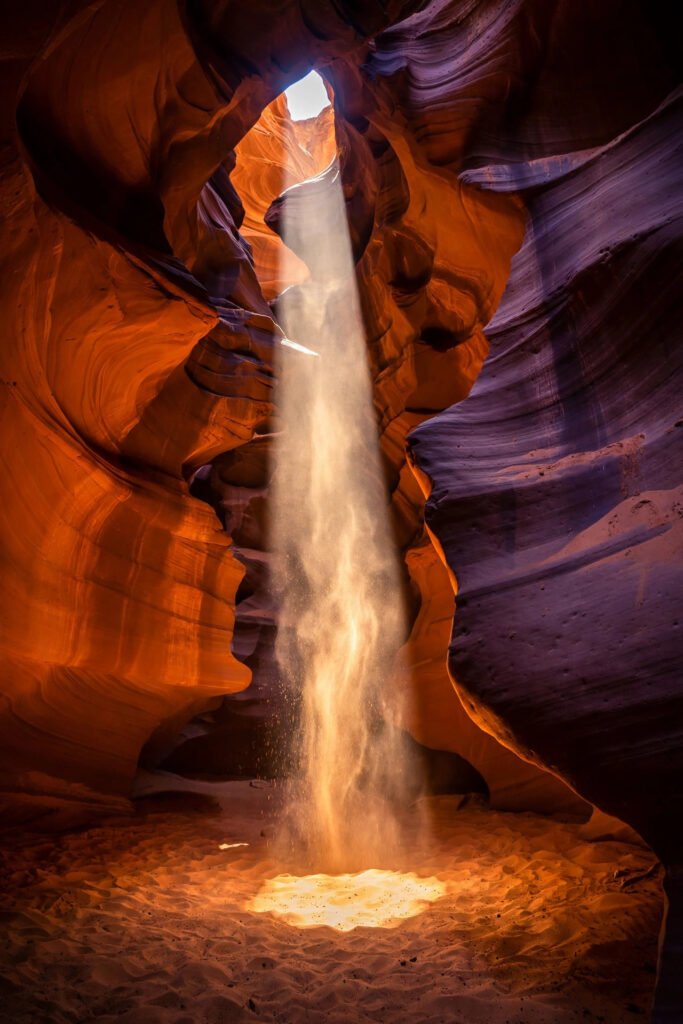
Why it works: One strong light source, one clear subject, and one slow camera move — that is the recipe for a clean AI video. The dust in the beam gives the clip its motion: tiny particles drifting and sparkling, which reads as alive without any complex movement. Ask for the beam to be “vertical” and the walls “curving overhead” and the model will build the right geometry.
Prompt 2: The Spiral Walls of Lower Canyon
Lower Antelope Canyon has no famous beams, but it has something just as beautiful: corkscrew walls that twist and fold like ribbon, in shades of orange, pink, lavender, and gold. This prompt is a slow journey through those shapes.
Slow cinematic video gliding through Lower Antelope Canyon, swirling spiral sandstone walls in orange, pink and lavender, soft reflected light washing over the smooth rock curves, metal ladders descending into the narrow canyon, gentle forward camera movement, peaceful and otherworldly mood, photorealistic, rich warm colorsImage-prompt idea: Lower Antelope Canyon spiral sandstone walls, swirling orange pink and lavender rock formations, soft reflected light, metal ladders descending into the canyon.
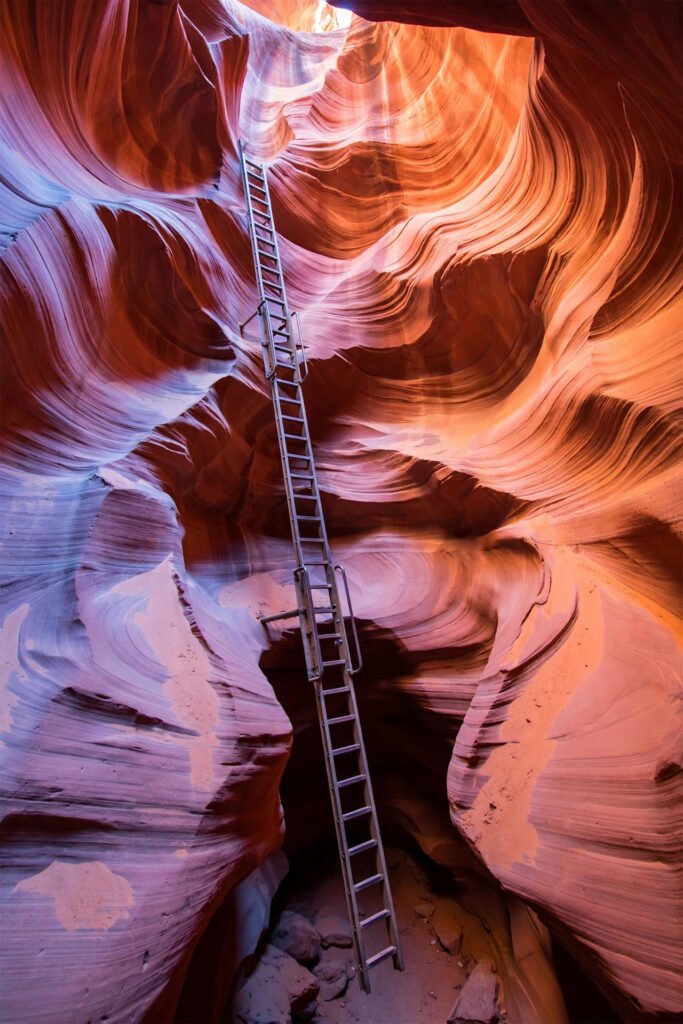
Why it works: A slow forward glide through a narrow passage is one of the most stable moves in AI video — the walls slide past smoothly on both sides. The colour words do heavy lifting here: “orange, pink and lavender” tells the model that Lower Canyon is cooler and more varied than the deep orange of Upper Canyon. The ladders add scale and a human touch without putting a person in frame.
Prompt 3: Light and Dust Close-Up
Sometimes the most powerful clip is the smallest one: a tight close-up of a single beam, dust drifting through it, the sandstone texture filling the frame. This prompt is perfect for a meditative middle clip or a looping background video.
Extreme close-up video of a golden light beam inside Antelope Canyon, dust particles floating and sparkling in the shaft of sunlight, narrow slot of bright sky above, textured wavy sandstone in orange and red tones filling the frame, ethereal and dreamy glow, very slow camera movement, photorealistic, cinematic macro styleImage-prompt idea: Close-up of a golden light beam and floating dust inside Antelope Canyon, narrow slot of sky above, textured wavy sandstone in orange and red tones.
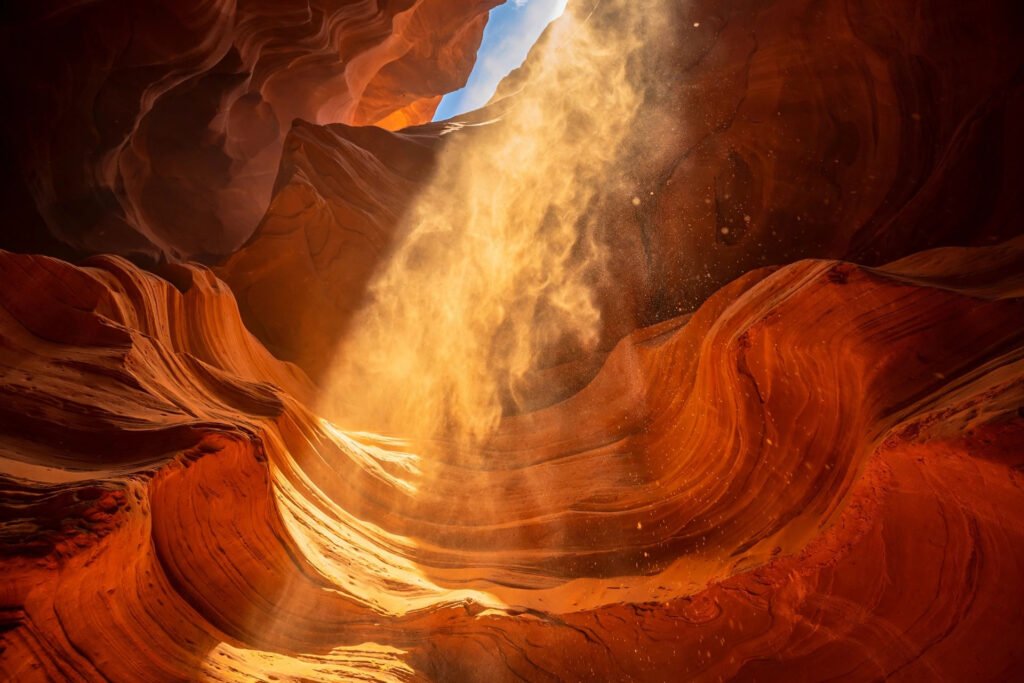
Why it works: Close-ups are forgiving because there is less scene for the model to keep consistent — just texture, light, and dust. The drifting dust is the only motion needed, and it is exactly the kind of slow, random movement AI renders well. This clip works beautifully as a background loop for meditation, travel, or relaxation content.
Prompt 4: Golden Hour Glow
Late in the day, when the sun is lower, the beams fade but the canyon glows differently: warm light washes across the sculpted curves, shadows deepen, and the whole place turns amber and violet. This prompt captures that softer, moodier light as a closing clip.
Antelope Canyon interior at golden hour, warm amber light washing over sculpted sandstone curves, deep soft shadows in the folds of the rock, orange and violet tones glowing on the walls, tranquil and timeless mood, slow cinematic camera drift, photorealistic, smooth and dreamyImage-prompt idea: Antelope Canyon interior at golden hour, warm light washing over sculpted sandstone curves, deep soft shadows, dramatic canyon interior.
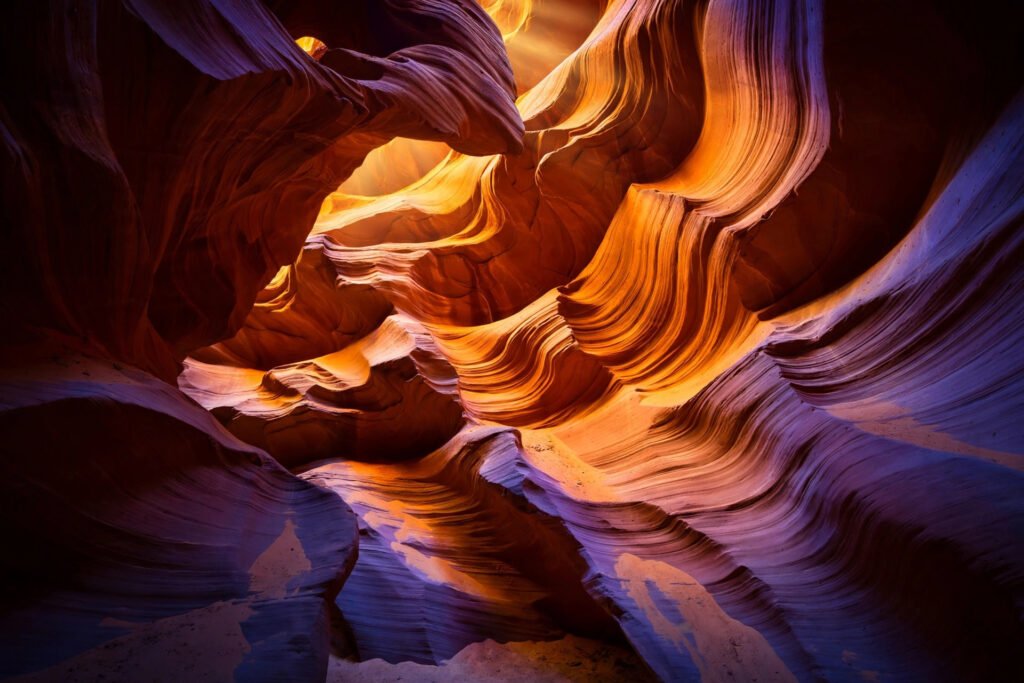
Why it works: Golden hour light is softer and more even than the harsh midday beam, which means fewer blown-out highlights and a more cinematic result. The slow drift lets the viewer absorb the shapes. Use this as the final clip in your sequence — it feels like a gentle ending after the drama of the midday beam.
For more canyon and waterfall light, see our misty mountain waterfall prompts (https://pkpk.fun/misty-mountain-waterfall-ai-video-prompts/) — the same slow-drift approach works for any narrow, dramatic landscape.
How to Use These Prompts
Paste each prompt exactly as written into Runway, Kling, Luma Dream Machine, Pika, or Google Veo. Generate at the highest quality setting and keep clips 5–10 seconds long. A good sequence is: Prompt 1 (the midday beam) as the hook, Prompt 2 (Lower Canyon) to show variety, Prompt 3 (the close-up) as a dreamy pause, and Prompt 4 (golden hour) as the closer. Add ambient music or soft desert wind sounds, and a simple text overlay — “Antelope Canyon, Arizona” — in the first frame.
One important tip: do not ask for the beam and the canyon in the same breath as fast camera movement. Slow is the whole point of this place. If a result looks muddy or the walls look like melted plastic, add “smooth sandstone, flowing rock curves” and regenerate — the model usually cleans up the geometry on the second try.
If you ever visit in real life, remember the rules that protect this sacred place. Antelope Canyon is on Navajo Nation land and can only be entered with a licensed Navajo guide. The official Navajo Nation Parks & Recreation site (http://navajonationparks.org/) lists the Lake Powell Navajo Tribal Park, which manages Upper and Lower Antelope Canyon, and their guided tour operators page (https://navajonationparks.org/guided-tour-operators/) lists authorised companies. Entry is $15 per person plus the tour cost, and tours sell out weeks ahead for midday beam season. For photography timing and Upper vs. Lower advice, the guide at PresetPro (https://www.presetpro.com/beautiful-photographs-of-antelope-canyon/) is a useful reference.
Watch: Antelope Canyon in Real Life
Watch real footage of Upper Antelope Canyon before you generate, so you can see how the beam actually looks and how the light moves across the walls.
FAQ
What are the best antelope canyon ai video prompts for light beam videos?
The four prompts in this post cover the essential shots: the midday beam in Upper Canyon, the spiral walls of Lower Canyon, a close-up of light and dust, and a golden-hour glow. Together they make a complete 30–40 second video.
Which AI video tool is best for Antelope Canyon videos?
Runway, Kling, Luma Dream Machine, Pika, and Google Veo all handle slot canyon scenes well. Rock and light are simple, slow subjects, so keep your camera moves slow and let the light do the work.
When do the Antelope Canyon light beams appear in real life?
The beams appear from mid-March through early October, strongest from May to August, between roughly 10:30 a.m. and 1:30 p.m. — peaking from 11 a.m. to 1 p.m. In winter the sun is too low for vertical beams.
Can I visit Antelope Canyon without a guide?
No. Antelope Canyon is on Navajo Nation land and can only be entered with a licensed Navajo guide. Book a tour in advance — midday beam-season slots sell out weeks ahead, especially on summer weekends.
What is the difference between Upper and Lower Antelope Canyon?
Upper Antelope Canyon (Tsé bighánílíní, “the place where water runs through rocks”) is wider, has a flat floor, and is famous for the vertical light beams. Lower Antelope Canyon (Hazdistazí, “spiral rock arches”) is narrower and deeper, with ladders and more sculptural, colourful walls.
Why is Antelope Canyon so famous in photography?
Its smooth, flowing sandstone walls and midday light beams create images that look almost unreal. In December 2014, photographer Peter Lik reportedly sold a black-and-white print of the canyon, “Phantom,” for $6.5 million.
Conclusion
Antelope Canyon is proof that the most spectacular scenes are sometimes the simplest: rock, light, and dust. With these four antelope canyon ai video prompts, you can recreate the magic — the midday beam pouring onto the canyon floor, the spiral walls of the Lower Canyon, a close-up of light and dust, and the golden-hour glow. Copy the prompts, generate short clips, and stitch them into a video that feels like standing inside the canyon at noon. Try them today, and see which beam your audience loves most.