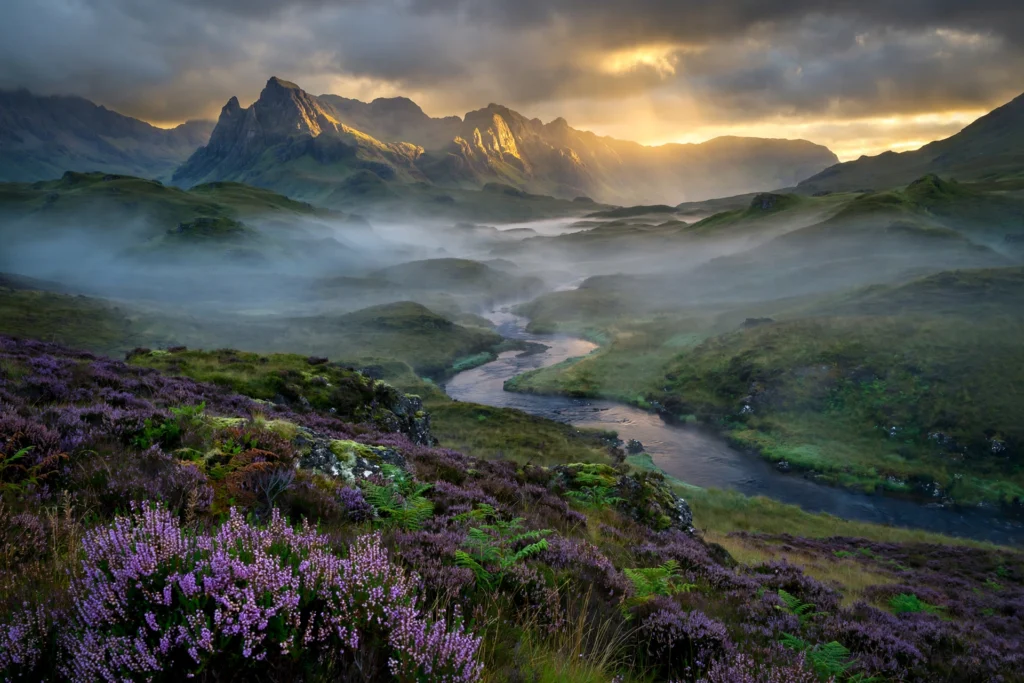
If one landscape was made for AI video, it is the Scottish Highlands: mist rolling through glens, purple heather, black lochs, and castles that look older than time. These scottish highlands ai video prompts turn that drama into four ready-to-generate clips — Glencoe, the Isle of Skye, Loch Ness and the Glenfinnan Viaduct — each written as a single clean shot with the camera move, light and mood built in. Paste one into Sora, Runway, Kling, Veo or Hailuo and you will have a cinematic Highland film in minutes.
The Highlands cover the wild north and west of Scotland, from the Great Glen to the Isle of Skye. This is the land of the movies — Harry Potter’s Hogwarts Express crosses the Glenfinnan Viaduct, James Bond’s Skyfall was filmed in Glen Etive, and Glencoe’s Three Sisters have starred in countless films. That film history is a gift for AI creators: the models have seen these landscapes thousands of times, so they render them unusually well, as long as your prompt stays specific and disciplined.
Table of Contents
- 4 Scottish Highlands AI Video Prompts
- 1. Glencoe Valley in the Mist
- 2. The Old Man of Storr, Isle of Skye
- 3. Loch Ness and Urquhart Castle
- 4. The Glenfinnan Viaduct Steam Train
- Tips to Make Your Scottish Highlands AI Videos Look Real
- Watch: Scotland in 4K
- Frequently Asked Questions
- Conclusion
4 Scottish Highlands AI Video Prompts
Below are four ready-to-use scottish highlands ai video prompts, one for each of the Highlands’ most iconic scenes. Use them in 16:9 for YouTube, or add “vertical 9:16, for Instagram Reels” to any prompt to reframe it for Shorts and Reels. Highland weather is your friend in AI video — mist and low cloud hide small errors and add instant atmosphere, so lean into the mood rather than fighting it.
1. Glencoe Valley in the Mist
Glencoe is the Highlands in one valley: steep green mountains, a winding road, and weather that changes every ten minutes. A slow drone shot here is the definitive Highland opener, and it works as the first clip of any Scotland video.
Cinematic aerial drone shot gliding slowly forward over Glencoe valley in the Scottish Highlands at dawn. Steep green mountains rise on both sides, low mist drifts through the glen, a single narrow road winds below, a lone hiker with a backpack walks along a ridge. Golden light breaks through moody clouds, painterly atmosphere, photorealistic, 4K, 10 seconds, no text.Image-prompt idea: “Drone view of Glencoe valley in the Scottish Highlands at dawn, steep green mountains, low mist, a winding road and a lone hiker, golden light through moody clouds, cinematic travel photography.”

Why it works: the prompt anchors the vast valley with two small human-scale details — the road and the hiker — so the scene has scale instead of just empty green. Mist is doing real work here: it gives the model permission to be soft and atmospheric rather than hyper-detailed.
2. The Old Man of Storr, Isle of Skye
The Old Man of Storr is a jagged rock pinnacle on the Isle of Skye, and it is one of the most photographed rock formations in Britain. At dawn, with pink light and sea mist, it looks like the edge of the world — a perfect second clip after Glencoe.
Cinematic wide shot of the Old Man of Storr rock pinnacle on the Isle of Skye, Scotland at dawn. Jagged dark rock formations tower over a green hillside, soft pink and gold sky, thin sea mist drifting in the distance. Camera rises slowly, revealing more of the coastline below. Moody, epic, photorealistic, 4K, 10 seconds, no text.Image-prompt idea: “The Old Man of Storr rock pinnacle on the Isle of Skye at dawn, jagged dark rocks, green hillside, pink and gold sky, sea mist, cinematic travel photography.”

Why it works: naming the exact formation keeps the model from inventing a generic mountain. The slow rising camera is one of the safest moves in AI video — it reveals the landscape gradually and rarely warps anything.
3. Loch Ness and Urquhart Castle
Every Highlands video needs a loch, and Loch Ness is the most famous of them all. The ruined Urquhart Castle on its shore gives the shot a story — history, mystery, and a reason for the camera to linger.
Cinematic slow push-in on the ruins of Urquhart Castle on the shore of Loch Ness in the Scottish Highlands. Ancient grey stone walls above dark, still loch water, misty forested mountains behind, soft morning light, a faint ripple crossing the water. Quiet, mysterious, photorealistic, 4K, 10 seconds, no text.Image-prompt idea: “Urquhart Castle ruins on the shore of Loch Ness in the Scottish Highlands, ancient stone walls, dark still water, misty mountains, soft morning light, cinematic travel photography.”

Why it works: still water is one of the hardest things for AI video, so the prompt keeps the motion tiny — a faint ripple — instead of asking for waves. The castle gives the eye a fixed anchor, so the model does not drift while generating the loch.
4. The Glenfinnan Viaduct Steam Train
The money shot of the Highlands: a steam train crossing the curved Glenfinnan Viaduct, the same bridge the Hogwarts Express crosses in the Harry Potter films. It is the most shareable clip of the four, and the perfect closer.
Cinematic wide shot of a black steam train crossing the curved stone Glenfinnan Viaduct in the Scottish Highlands. White steam billows from the locomotive, the viaduct arches over a deep green valley, mist clings to dramatic mountains behind. Camera holds steady, then pans slowly to follow the train. Golden hour light, epic, photorealistic, 4K, 10 seconds, no text.Image-prompt idea: “Steam train crossing the curved Glenfinnan Viaduct in the Scottish Highlands, white steam, green valley below, misty mountains, golden hour light, cinematic travel photography.”

Why it works: the train is a strong moving subject, which is exactly what video models need — something to track through the frame. The “hold steady, then pan to follow” instruction mirrors how a real camera operator would shoot it, and that realism shows in the result.
Tips to Make Your Scottish Highlands AI Videos Look Real
Use the weather. Mist, drizzle and low cloud are not problems in Highland videos — they are the look. Prompts that include mist and moody skies come out more convincing than bright blue-sky versions, because soft light forgives small AI mistakes.
Keep the palette muted. The Highlands are green, grey, brown and purple heather — not tropical turquoise. If your generations look too saturated, add “muted natural colours, overcast Scottish light” and the result will feel far more authentic.
One subject, one move. A valley, a pinnacle, a castle, a train — each prompt above has one hero and one camera move. The moment you add a second subject or a second move, the model starts guessing, and Highland landscapes punish guessing with warped ridges.
Generate the still first. For Glencoe and the Storr especially, generate the image, check the mountain shapes look plausible, then animate with image-to-video. A bad still will never become a good video, and one image credit is cheaper than five failed video rolls.
Cut in story order. Glencoe (arrival), Skye (wonder), Loch Ness (mystery), Glenfinnan (finale) — that is a complete Highland journey in 40 seconds. Add a soft piano or Celtic instrumental track, keep the cuts slow, and let the mist do the talking.
For more northern inspiration, try our Iceland waterfalls AI video prompts and our Swiss Alps train journey AI video prompts, or go somewhere warmer with our Banff AI video prompts.
Watch: Scotland in 4K
Before you generate, watch the real Highlands — this cinematic 4K film from Cinematic Earth 4K travels through the glens, lochs, castles and the Isle of Skye, and it is the best reference for the light, colour and pacing your AI clips should aim for.
Frequently Asked Questions
Which AI video tool works best for Scottish Highlands prompts?
Runway Gen-4, Sora, Kling and Google Veo all render Highland landscapes well, because the models have seen so much real footage of Glencoe and Skye. Runway gives the most camera control, Sora is strongest on mist and atmosphere, and Kling is the best budget option for 5–10 second clips. The prompts above are tool-neutral.
Why does mist help AI Highland videos look real?
Mist softens edges and hides detail, which is exactly where AI video usually fails — fine textures like grass, rock and distant trees. A misty prompt gives the model a natural reason to be soft, so small errors disappear into the atmosphere instead of standing out.
Can I use these Scottish Highlands AI videos commercially?
It depends on your AI tool’s plan and terms — most paid plans allow commercial use of generated video, while free tiers often do not. Check your tool’s licence before using a clip in a client project or monetised video, and never present AI footage as real drone footage of Scotland.
How long should each Highlands AI clip be?
Five to ten seconds per clip is ideal. Longer generations give the model time to warp mountains and drift the camera. Generate four 10-second clips and edit them together instead of asking for one 40-second video.
Can I make vertical versions for Reels and Shorts?
Yes. Add “vertical 9:16 aspect ratio, framed for a phone screen” to any prompt above, and keep the hero subject — the valley, the pinnacle, the castle, the train — in the centre of the frame so it survives the crop.
What music works best with Highlands AI videos?
Slow piano, soft Celtic strings, or ambient drone music fits the Highlands far better than upbeat pop. Keep the music quieter than you think — the landscape is the star, and the edit should feel calm, misty and unhurried.
Conclusion
The Scottish Highlands reward patience — in real travel and in AI video. These four scottish highlands ai video prompts give you the Highlands’ greatest hits: Glencoe in the mist, the Old Man of Storr at dawn, Loch Ness and its ruined castle, and the steam train crossing Glenfinnan. Copy them, generate your stills first, keep one camera move per clip, and edit the four scenes in story order. The result is a 40-second film that feels like a week in the Highlands — fog, heather, history and all.
Plan a real trip with VisitScotland’s Highlands guide, learn the history from Wikipedia’s Scottish Highlands page, and read the ReelMind guide to AI Highland scene prompts.
Pingback: Edinburgh AI Video Prompts: 4 Cinematic Prompts for the Castle, Arthur's Seat & Calton Hill