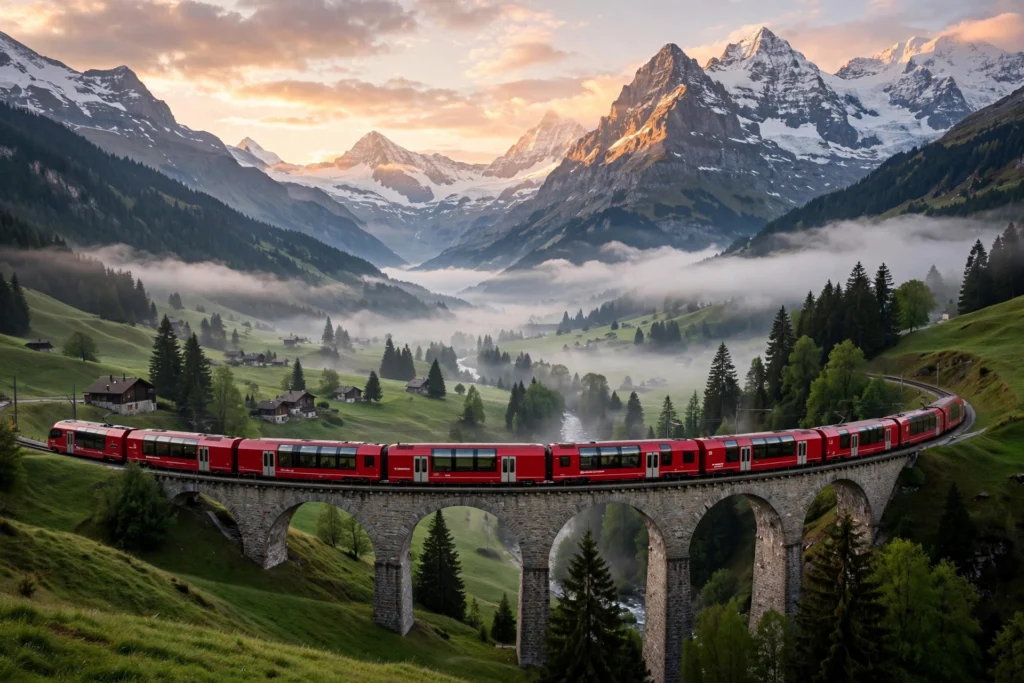
Swiss Alps Train Journey AI Video Prompts: Ride the World’s Most Beautiful Railway Without a Ticket
A red train curves across a stone viaduct, snow-capped peaks rise on both sides, and a turquoise lake slides past the window — the Swiss Alps by train is widely called the most scenic railway journey on Earth. With the right Swiss Alps train journey AI video prompts, you can recreate that ride in a 10-second clip, no Swiss Travel Pass required. Tools like Veo 3, Kling, Runway, and Sora render mountain railways beautifully, because the scenes have strong geometry (the train, the viaduct, the peaks) and slow, predictable motion.
In this post, you will get four copy-paste-ready Swiss Alps train journey AI video prompts, each built around a different iconic moment: the Glacier Express winding through a green summer valley, the Bernina Express crossing the famous Landwasser Viaduct, a dreamy lake view from inside a panoramic carriage, and a magical winter ride through deep snow. Every prompt includes camera movement, lighting, and mood, so your clip feels like a real journey — not a screensaver.
Train content is one of the most satisfying niches on short-form video. Viewers love the feeling of movement, the changing landscape, and the gentle rhythm of the rails. Swiss train videos, in particular, perform well because the scenery is so extreme: the contrast of a small red train against enormous white mountains creates a sense of scale that stops the scroll instantly. And because the Grand Train Tour of Switzerland connects 1,280 kilometres of panoramic routes past 11 large lakes, you will never run out of variations on the theme.
Table of Contents
- Why Swiss Train Videos Go Viral
- How to Use These Swiss Alps Train Journey AI Video Prompts
- Prompt 1: Glacier Express in a Green Valley
- Prompt 2: Bernina Express on the Landwasser Viaduct
- Prompt 3: Lake View From the Train Window
- Prompt 4: Winter Train Through Deep Snow
- Watch the Real Bernina Express for Inspiration
- Pro Tips for Realistic Train AI Videos
- Frequently Asked Questions
- Conclusion
Why Swiss Train Videos Go Viral
There are three reasons Swiss train clips outperform almost every other travel video. First, motion: a moving train gives the viewer a journey, not a postcard. The landscape changes every second, which holds attention far longer than a static mountain photo. Second, scale: the tiny red train against giant peaks makes the viewer feel the size of the Alps in a way no wide landscape shot can. And third, comfort: train videos feel safe and relaxing. People watch them to unwind, to dream about travel, and to fall asleep — and relaxed viewers save, share, and rewatch.
AI video tools are also unusually good at trains. A train is a simple, rigid shape moving along a predictable path, which is exactly the kind of motion models render most reliably. The real challenge is the background — mountains, valleys, lakes — and Swiss scenery is so well photographed that the models have excellent reference material. The result is a clip that often looks indistinguishable from real footage, especially at the small size of a phone screen.
For creators, the Swiss Alps are a goldmine of series ideas: one famous route a week (Glacier Express, Bernina Express, Gotthard Panorama Express, Brienz Rothorn steam train), one season at a time, or window-view compilations set to relaxing music. One strong set of Swiss Alps train journey AI video prompts can power a whole travel channel for months.
How to Use These Swiss Alps Train Journey AI Video Prompts
Train prompts need one thing above all: a clear camera position. Say whether the camera is outside the train (a drone following it, a wide shot of the viaduct) or inside the train (a window view, a coffee cup on the table). Mixing the two in one prompt confuses the model and produces a jumpy clip. Pick one viewpoint per prompt and commit to it.
Second, name the train. “Red Glacier Express panoramic train” or “Bernina Express” gives the model a specific, well-known visual anchor — much better than a generic “train”. Third, set 9:16 vertical (1080 x 1920) for Shorts, Reels, and TikTok, keep clips to 8–12 seconds, and generate each prompt two or three times, keeping the best take. Check the train’s shape in every generation: wheels, windows, and carriages are where AI still slips.
If you want to plan a whole series, the Swiss Alps by Train itinerary maps the classic route from Zurich through Lucerne and Interlaken to Jungfraujoch and Zermatt, with the Glacier Express and the Gornergrat — real route knowledge that makes your captions and voiceovers sound like you have actually ridden the line. For the craft of nature and landscape prompting, the nature and wildlife prompt breakdown explains how named elements (a viaduct, a lake, a glacier) give AI video models a stronger vocabulary than vague descriptions like “beautiful mountains”.
Prompt 1: Glacier Express in a Green Valley
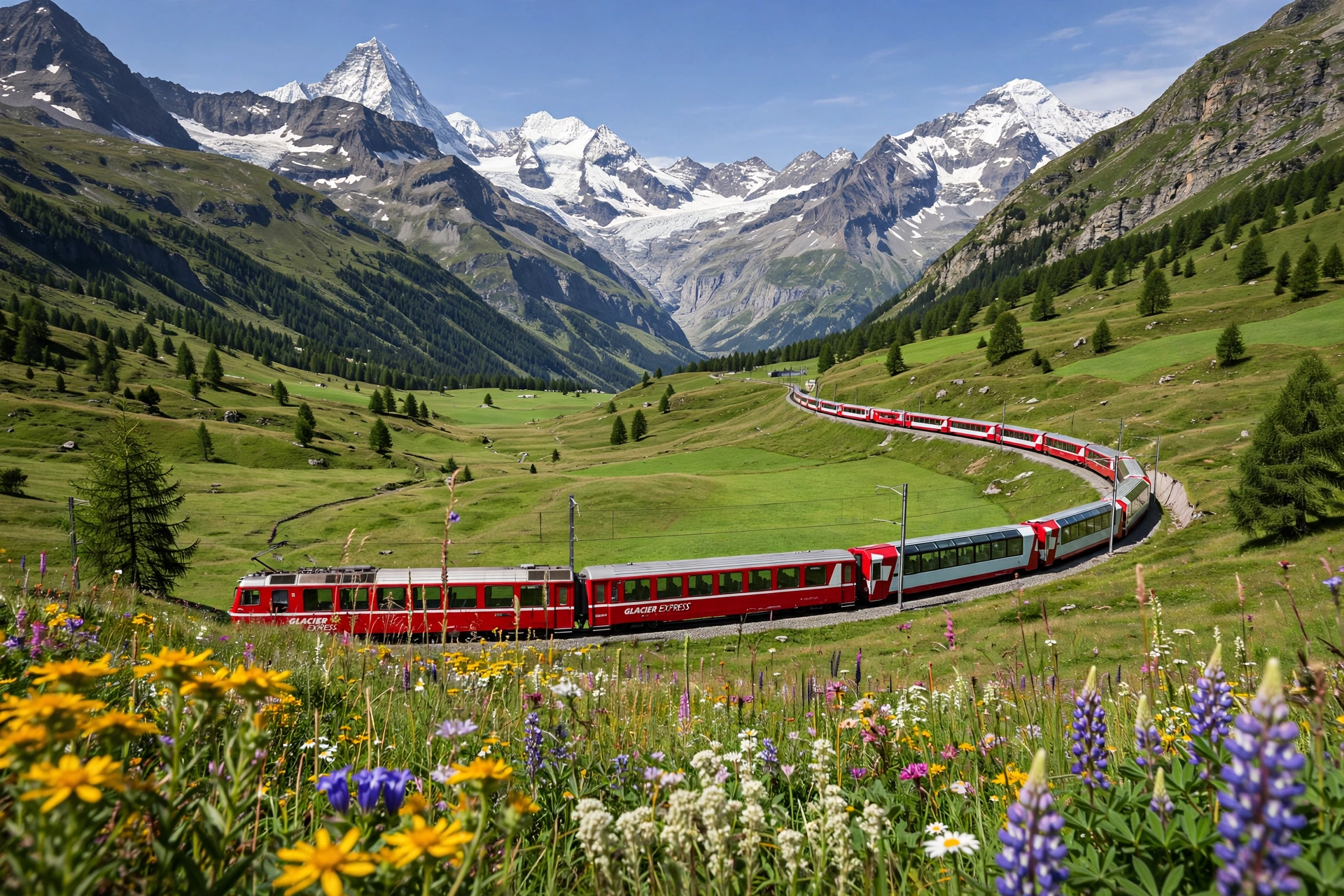
The Glacier Express is the slowest express train in the world — and that is its charm. This prompt creates a bright summer scene of the famous red train winding through a green valley full of wildflowers, with snow-capped peaks behind. It is the most cheerful, colourful prompt in this set, perfect for summer travel content, “bucket list” Reels, and channel trailers.
Stunning 10-second cinematic video of the red Glacier Express panoramic train winding through a green Swiss Alps valley in summer, wildflower meadows in the foreground and snow-capped peaks behind. The train moves slowly along the curving track as morning sunlight lights up the mountains. Smooth drone camera following the train from above and to the side, joyful and epic mood, vivid green and white colours, photorealistic, 4K quality. 9:16 aspect ratio, 10 seconds, no text, no watermark.Image-prompt idea: “Red Glacier Express train winding through a green Swiss Alps valley with wildflowers and snow-capped peaks, summer morning light, photorealistic travel photography.”
Why it works: The prompt gives the model a single clear subject (the red train), a single camera move (drone following from the side), and a strong colour contrast (red train, green valley, white peaks). The slow speed is also realistic — the Glacier Express really does crawl through the mountains, which means slow AI motion looks correct rather than sluggish. For more mountain scenery in a different mood, see our snowy mountain cabin AI video prompts, which trade the train for a cosy fireplace.
Prompt 2: Bernina Express on the Landwasser Viaduct
The Landwasser Viaduct is the most famous railway bridge in the world: a tall stone curve that carries the train straight into a tunnel through the cliff. This prompt captures that dramatic moment — the red Bernina Express curving across the viaduct with pine forest and cliffs below. It is the most “wow” shot in this set, ideal for viral Shorts and “most beautiful train journey” compilations.
Dramatic 10-second cinematic video of the red Bernina Express train curving across the tall stone Landwasser Viaduct in the Swiss Alps, dramatic cliffs and pine forest far below, soft golden evening light on the mountains. The camera holds a wide angle as the train moves steadily across the bridge and toward the tunnel. Epic and awe-inspiring mood, warm gold and deep green tones, photorealistic, 4K quality. 9:16 aspect ratio, 10 seconds, no text, no watermark.Image-prompt idea: “Bernina Express train curving across the Landwasser Viaduct in the Swiss Alps, cliffs and pine forest below, golden evening light, photorealistic travel photography.”
Why it works: The viaduct gives the scene a strong, simple structure — one bridge, one train, one direction — which is exactly what AI video needs to stay stable. The Bernina Express is also a UNESCO World Heritage railway, so the scene carries real prestige that viewers recognise. A useful tip: generate this one in 16:9 as well, because the wide viaduct shot makes a stunning YouTube thumbnail or channel banner.

Prompt 3: Lake View From the Train Window
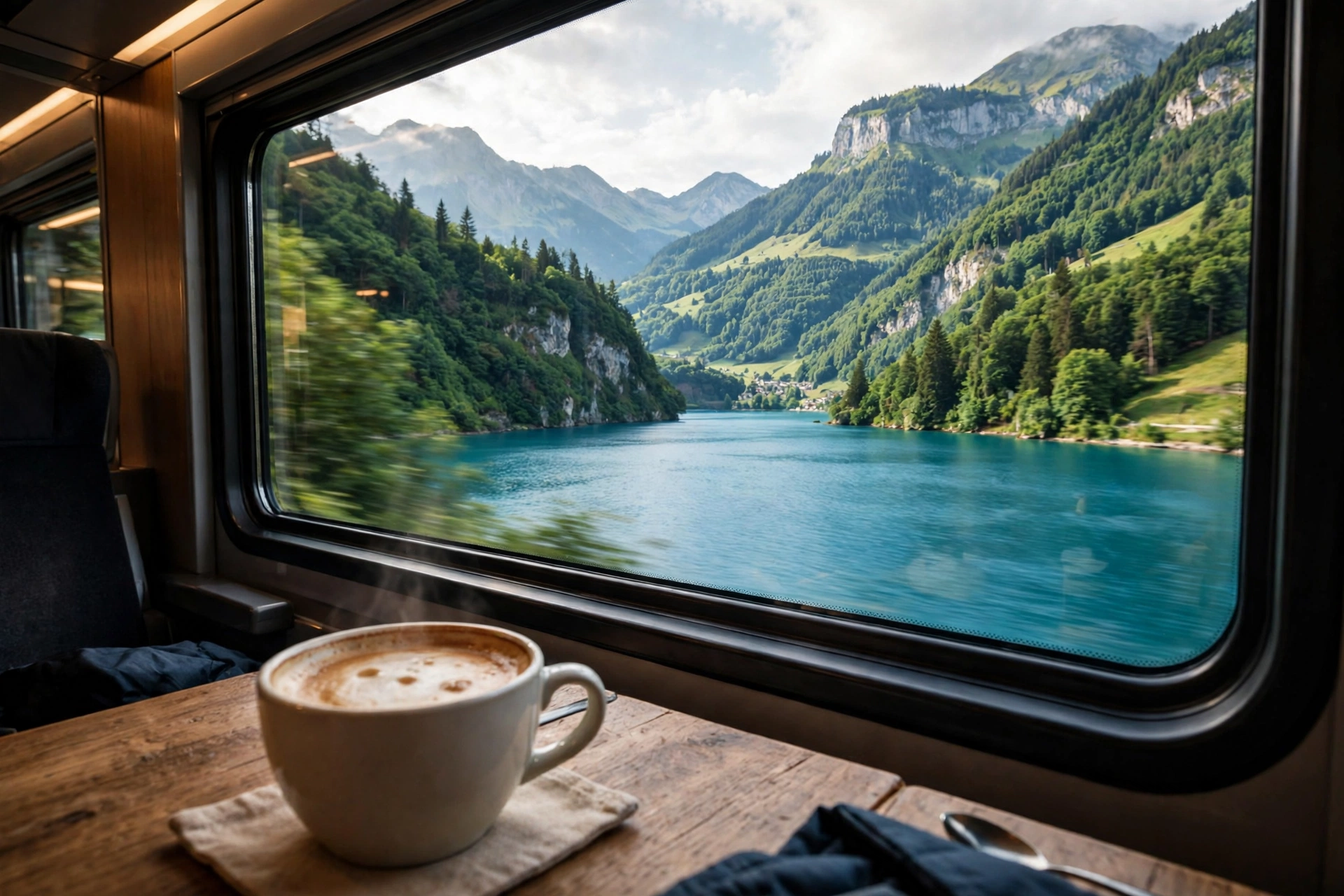
Sometimes the best train video is not of the train at all — it is the view from inside. This prompt creates a cosy, first-person scene: turquoise Lake Brienz sliding past a panoramic window, green mountains beyond, and a coffee cup on the table in the foreground. It feels personal and real, like a memory from an actual journey, and it is perfect for “slow travel” content, study backgrounds, and ASMR-style videos with the gentle sound of the rails.
Cozy 10-second cinematic video from inside a Swiss panoramic train carriage, looking out of a large window at turquoise Lake Brienz and green mountains sliding past. A coffee cup sits on the table in the foreground, warm interior light contrasts with the bright daylight outside. Slow and steady camera, the landscape drifting gently by, calm and dreamy mood, photorealistic, 4K quality. 9:16 aspect ratio, 10 seconds, no text, no watermark.Image-prompt idea: “View from inside a Swiss panoramic train window, turquoise lake and green mountains passing by, coffee cup on the table, warm interior light, photorealistic.”
Why it works: The fixed foreground (the coffee cup and table) gives the model a stable anchor, while the moving background creates the feeling of travel. This foreground-background trick is one of the most reliable techniques in AI video: the model only needs to move one layer, not the whole scene. The same technique appears in the AI video innovations guide, which shows how a fixed subject with a moving background produces the most believable motion. For a similar window-view feeling at night, our northern lights aurora sky AI video prompts use the same calm, slow pacing under a glowing sky.
Prompt 4: Winter Train Through Deep Snow
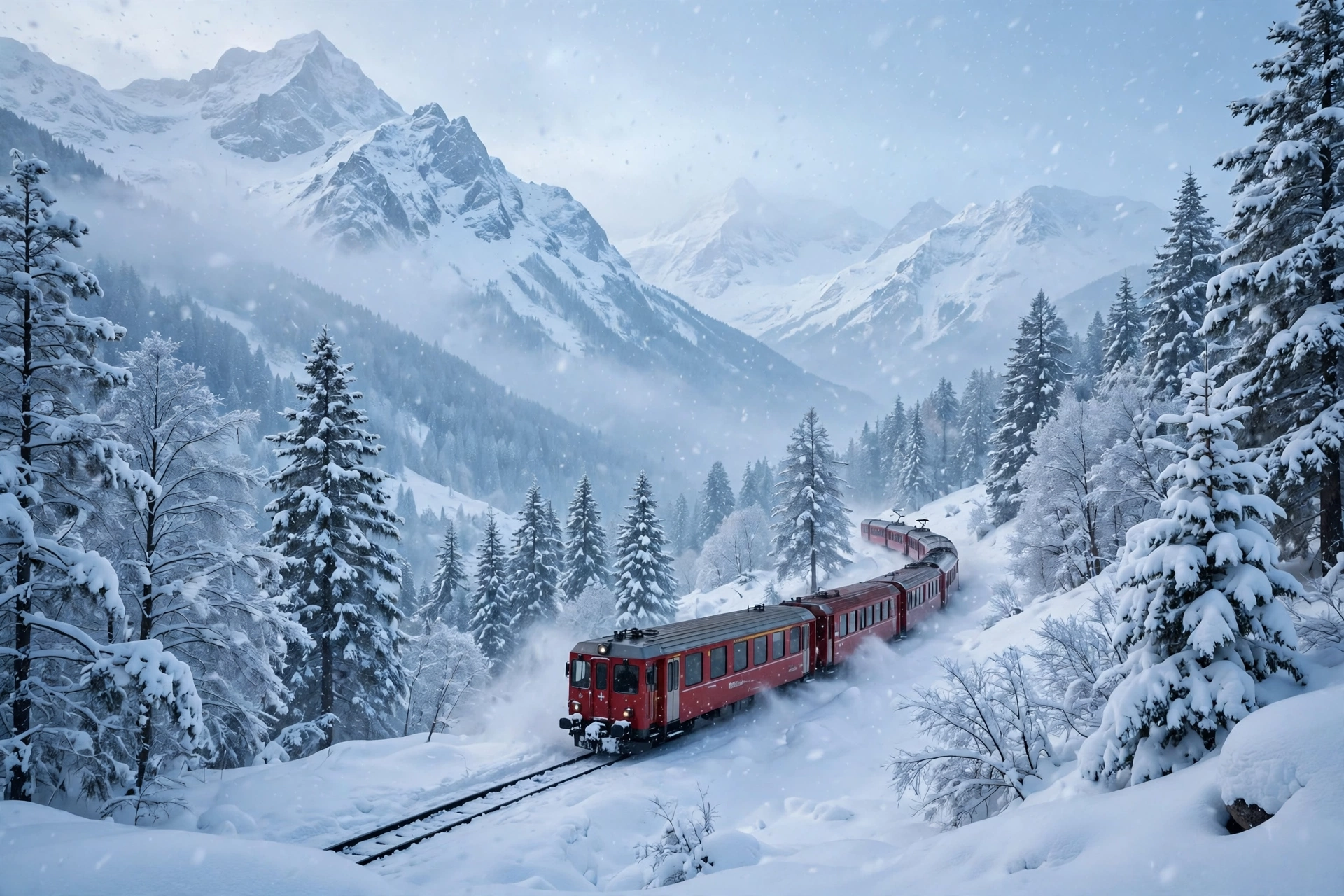
In winter, the Swiss Alps become a snow globe: white peaks, snow-covered pines, soft falling snow, and the red train cutting a path through it all. This prompt creates that magical scene — perfect for December content, Christmas travel compilations, and “winter wonderland” Shorts. It is also the easiest prompt in this set for AI to render well, because snow hides small imperfections.
Magical 10-second cinematic video of a red Swiss Alps train travelling through deep snow in winter, snow-covered pine trees and white mountain peaks on both sides, soft snowfall and pale blue winter light. The train moves steadily forward, snowflakes drifting past the camera, and warm light glows from the carriage windows. Slow tracking camera beside the train, serene and magical mood, white and soft blue tones, photorealistic, 4K quality. 9:16 aspect ratio, 10 seconds, no text, no watermark.Image-prompt idea: “Swiss Alps train travelling through deep snow in winter, snow-covered pine trees and white peaks, soft snowfall, pale blue light, photorealistic.”
Why it works: Snow is forgiving: soft light, low contrast, and a simple palette mean the model has very little detail to get wrong. The warm carriage windows add a lovely colour contrast — the only warm thing in a cold white world — which draws the eye straight to the train. Post this one in December for peak seasonal traffic, and pair it with gentle piano or a crackling fire sound. For more misty mountain atmosphere, our misty mountain waterfall AI video prompts use the same soft-light, slow-movement techniques in a summer valley.
Watch the Real Bernina Express for Inspiration
Before you generate, watch how the real Bernina Express moves: the slow curve across the viaduct, the way the carriages tilt into the bend, and how the landscape changes from green valleys to glaciers in a single journey. Notice the pacing — nothing rushes — and copy that calm rhythm into your prompts. This full scenic journey from Tirano to St. Moritz is the perfect reference:
Pro Tips for Realistic Train AI Videos
First, always fix the camera position in the prompt: outside the train or inside it, never both. Second, name the train and the place — “red Bernina Express” and “Landwasser Viaduct” beat “a train in the mountains” every time, because named things give the model a precise visual target. Third, keep the train moving slowly. Fast trains blur, wobble, and break apart in AI generations; slow trains look stately and real.
Fourth, check the train itself in every generation: count the carriages, look at the windows, and make sure the wheels sit on the track. If the train looks wrong, regenerate — a clean second take is always worth it. And finally, keep one consistent style across your series: same red train, same slow camera, same cinematic grade. Consistency is what turns four clips into a channel.
Frequently Asked Questions
Which AI video tool is best for Swiss Alps train videos?
Veo 3 (through Google Flow) currently gives the most realistic mountains, snow, and train motion. Runway Gen-4 offers the best camera control for drone-follow shots, Kling handles smooth tracking well, and Sora produces very cinematic wide shots. Test the same prompt in two tools and keep the better result.
Can I use Swiss Alps train journey AI video prompts for YouTube Shorts?
Yes. All four prompts are written for 9:16 vertical video at 1080 x 1920, which is the exact format for YouTube Shorts, Instagram Reels, and TikTok. Add relaxing train sounds or soft music and a caption like “The most beautiful train ride in the world” for best results.
How do I stop the train from looking distorted in AI video?
Keep the train moving slowly, use a wide or side angle rather than a head-on view, and describe the train precisely: “red panoramic train with large windows”. Avoid prompts with multiple trains or complex junctions. If a generation looks wrong, regenerate — trains are rigid shapes, and a clean take usually appears within two or three tries.
Are AI-generated train videos allowed on YouTube and Instagram?
Yes. Both platforms allow AI-generated content, but YouTube asks you to mark it with the “altered or synthetic content” disclosure when uploading. Do not claim the footage is real video you filmed in Switzerland — label it honestly as AI-generated.
What is the most scenic train journey in the Swiss Alps?
The Bernina Express (Tirano to St. Moritz) and the Glacier Express (Zermatt to St. Moritz) are the two most famous. The Bernina route is a UNESCO World Heritage railway and crosses the Landwasser Viaduct, while the Glacier Express is known as the slowest express train in the world and passes 291 bridges and 91 tunnels.
Can I monetise a channel made with Swiss train AI videos?
Yes, if you add original value: your own voiceover about the routes, real travel facts, editing, or a series format like “One Swiss train a week”. Channels that only re-upload raw AI clips with no added creativity struggle with monetisation, so always add your own story or knowledge.
Conclusion
These four Swiss Alps train journey AI video prompts give you a complete railway series: the cheerful Glacier Express in summer, the dramatic Bernina Express on the Landwasser Viaduct, the cosy lake view from the window, and the magical winter ride through deep snow. Copy a prompt, paste it into Veo 3, Runway, Kling, or Sora, and you will have a beautiful train clip in under a minute.
Start with the viaduct — it is the most dramatic shot and the most likely to go viral. Then build your series one route at a time, keeping the same red train, the same slow camera, and the same cinematic style. The Swiss Alps have inspired travellers for over a century; now they can inspire your audience too, one AI train ride at a time. All aboard.