Porto is a city that refuses to reveal itself quickly. It is smaller and steeper than Lisbon, built in tumbling tiers of granite and painted tile above a working river, and it wears its history lightly — wine lodges, azulejo churches and cafes that have not changed in a century. The Douro splits it from Vila Nova de Gaia, where every port lodge sits, and the great double-deck Dom Luís I bridge stitches the two banks together. That is why it photographs so well from every angle, and with the right Porto AI video prompts, you can recreate that river light without ever boarding a flight to Portugal.
These Porto AI video prompts are written for tools like Runway, Pika, Sora, Kling and Luma. Each one is copy-paste ready and built around a single famous location, a clear camera movement and the warm light that makes Porto glow — golden hour on the Ribeira, sunset from the bridge, soft daylight in the tiled station. Use them for travel Reels, YouTube Shorts, or as cinematic b-roll in a longer Portugal video. You do not need a flight to the Douro — just a good prompt and a sense of which scene to show first.
Below you will find four complete Porto AI video prompts: the Ribeira waterfront at golden hour, the Dom Luís I Bridge at sunset, the tiled hall of São Bento station, and a port wine cellar in Gaia. Each prompt includes an image-prompt idea so you can generate a matching still first and animate it. For the real places behind these scenes, the local-style Porto planning guide covers the river, the bridges and the lodges in practical detail.
Table of Contents
- What Are Porto AI Video Prompts?
- Prompt 1: The Ribeira at Golden Hour
- Prompt 2: The Dom Luís I Bridge at Sunset
- Prompt 3: São Bento Station in Blue and White
- Prompt 4: Port Wine Cellars in Gaia
- Watch: Best Things to Do in Porto 2027
- Tips for Better Porto AI Videos
- FAQs
- Conclusion
What Are Porto AI Video Prompts?
Porto AI video prompts are detailed text instructions that tell an AI video generator exactly what Porto scene to create. A vague prompt like “Porto Portugal” produces a generic European street. A precise prompt — naming the Ribeira, the camera movement, the golden-hour light and the rabelo boats on the Douro — produces footage that viewers instantly recognise as Porto.
The formula behind all four prompts below is simple: one location, one camera move, one time of day, one mood. “Slow aerial push-in over the Ribeira at golden hour” works because each word does a job. The location anchors the scene, the camera move creates motion, the time of day sets the colour, and the mood word — cinematic, peaceful, romantic — tells the generator how the shot should feel. Keep prompts under 100 words and avoid stuffing in five locations at once; AI video handles one clear scene far better than a tour of the whole city in a single clip.
Prompt 1: The Ribeira at Golden Hour
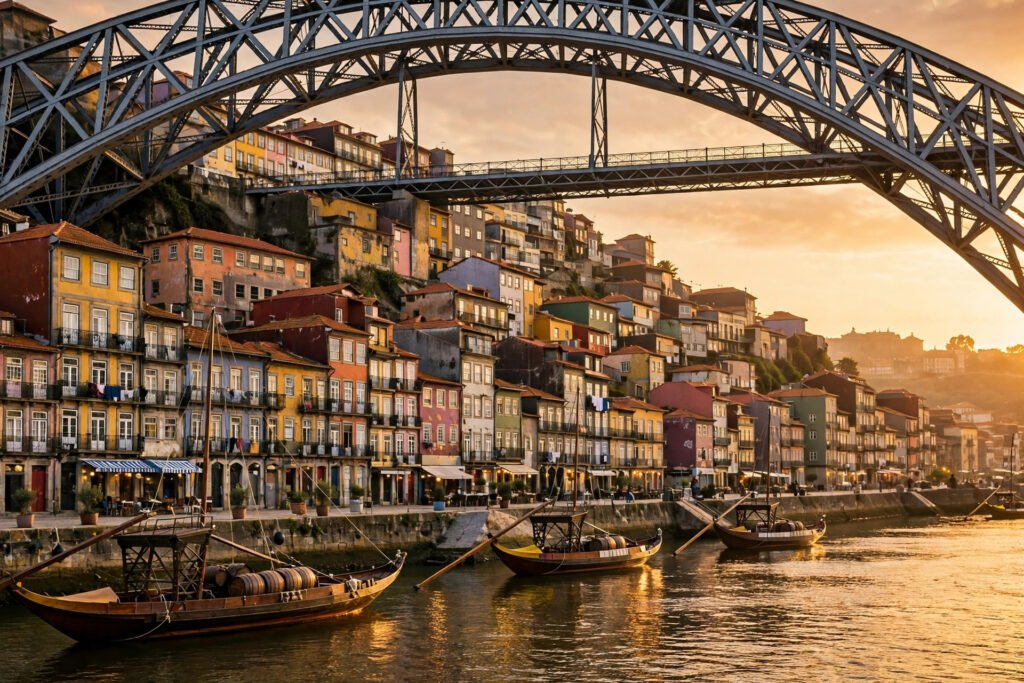
The Ribeira is the medieval quay where Porto began — six-storey houses in flaking ochre and blue stacked up the slope, arcades at water level, laundry on the balconies above, and traditional rabelo boats moored on the Douro. It is a UNESCO World Heritage site and the city’s postcard, and at golden hour the light turns the houses amber and the river into a sheet of gold. This is the single most important shot in any Porto video — the establishing image everything else hangs from.
Copy-paste prompt:
“Cinematic slow aerial shot over the Ribeira waterfront in Porto at golden hour, colourful tall houses stacked above the Douro River, traditional rabelo boats moored on the water, the Dom Luís I iron bridge arching overhead, warm amber light on the facades, lively and romantic, photorealistic, 4K travel film style.”
Image-prompt idea: “Cinematic photograph of Porto Ribeira waterfront at golden hour, colourful tall houses above the Douro River, traditional rabelo boats moored on the water, Dom Luís I bridge overhead, warm amber light.”
How to use it: Open your video with this shot and hold it for 6 to 8 seconds. An aerial or high-angle camera move works best for the Ribeira because it shows the stacked houses, the river and the bridge in one frame. Add a simple text overlay — “Porto, Portugal” — only after the first two seconds, so the image lands first. In real life, come at dawn or after 9 pm, when the quay stops being a bottleneck of visitors. If you want the same riverside formula for another Portuguese city, our Lisbon AI video prompts use it for the Tagus waterfront and the trams.
Prompt 2: The Dom Luís I Bridge at Sunset
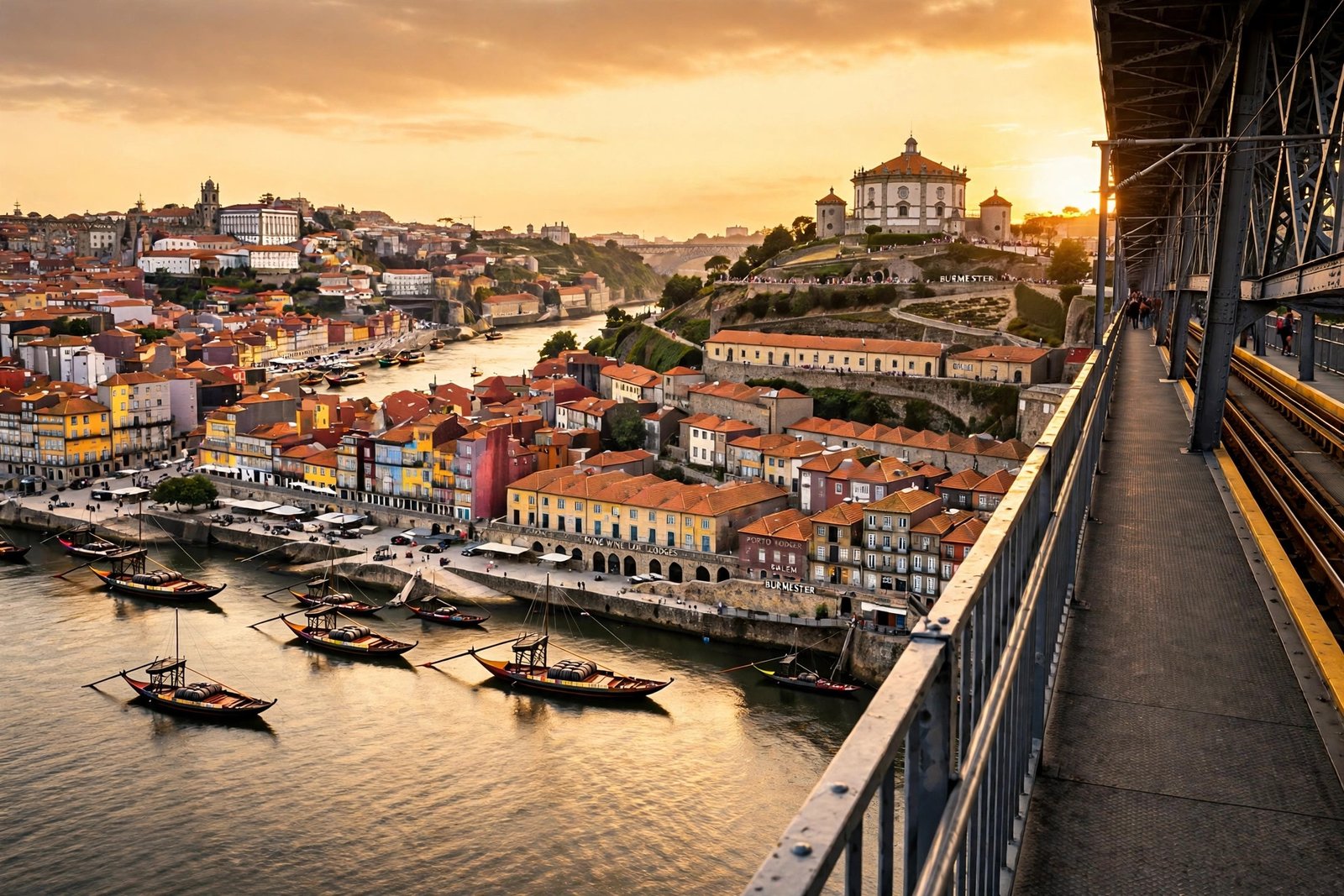
The Dom Luís I Bridge is Porto’s most iconic structure — a double-deck iron arch designed by Théophile Seyrig, who had worked with Gustave Eiffel on the neighbouring Maria Pia bridge, which is why people keep crediting Eiffel with it. The upper deck opened in 1886 and carries the metro and a walkway high above the river; the lower deck, opened a year later, drops you straight into the Gaia quayside. The view from the middle of the upper deck, downriver over the tiled roofs with the rabelo boats below, costs nothing and is hard to beat. It is the most romantic shot in the city — and one of the easiest for AI video to get right, because the composition is so simple: arch, river, rooftops.
Copy-paste prompt:
“Cinematic shot from the upper deck of the Dom Luís I Bridge in Porto at sunset, the double-deck iron arch framing terracotta rooftops and the Douro River below, rabelo boats drifting on golden water, Vila Nova de Gaia across the river, warm evening light, romantic and timeless, photorealistic, 4K travel film.”
Image-prompt idea: “Photograph from the upper deck of the Dom Luís I Bridge in Porto at sunset, terracotta rooftops and the Douro River below, rabelo boats on golden water, Vila Nova de Gaia across the river.”
How to use it: Keep the camera high and slow so the panorama fills the frame — that is what makes this shot feel expensive. Use it as the second clip in your video, right after the Ribeira, to move the story from the water up to the skyline. A gentle piece of fado guitar fits the mood far better than an upbeat travel track. For another bridge-and-river city in the same series, see our Barcelona AI video prompts.
Prompt 3: São Bento Station in Blue and White
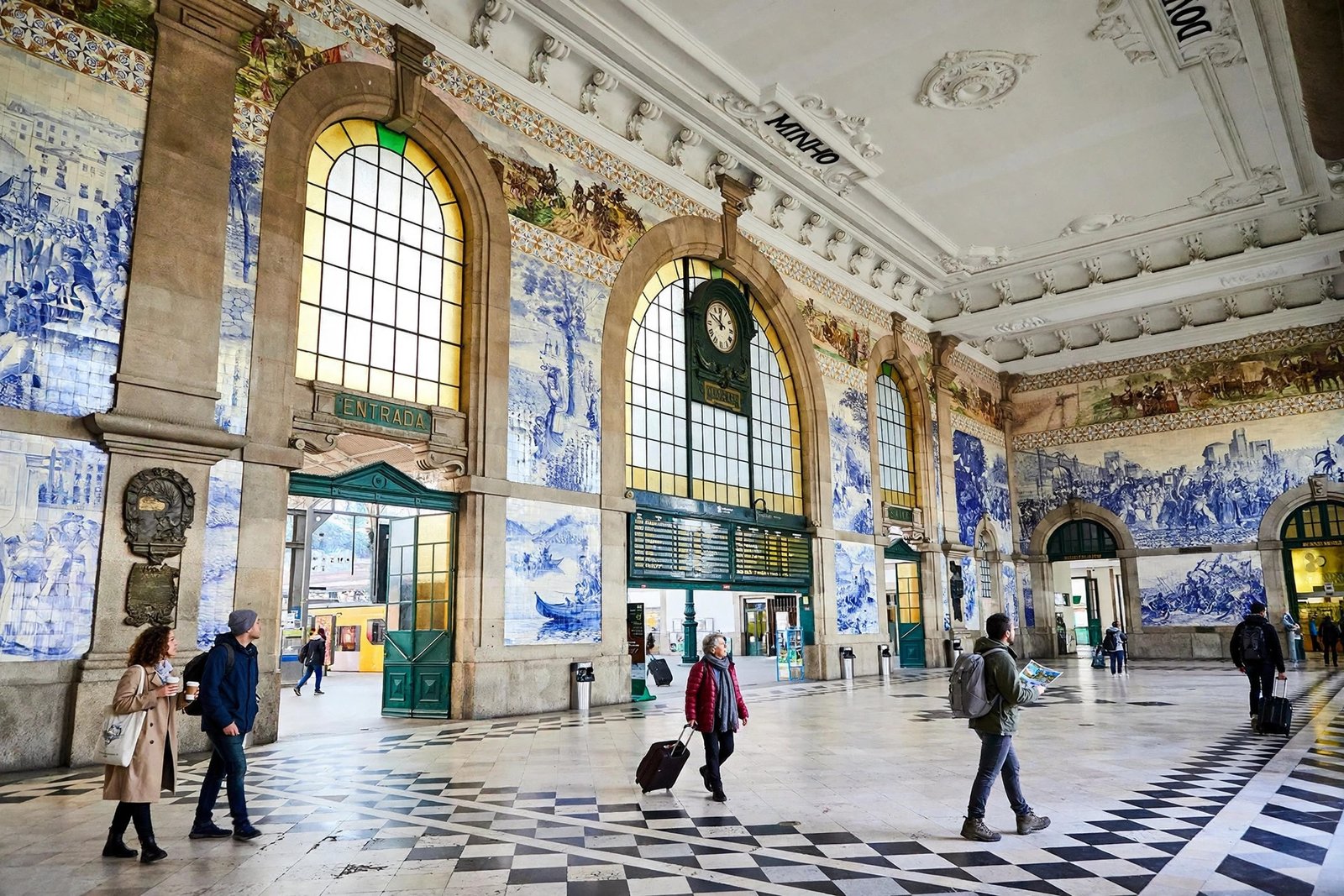
São Bento station is the most beautiful railway station in Portugal, and one of the finest interiors in the country. Its entrance hall is lined with around 20,000 azulejo tiles, laid between 1905 and 1916 by Jorge Colaço, depicting Portuguese battles, royal processions and rural life. It is still a working station, it is free to enter, and it takes ten minutes to see — but the blue-and-white hall is so photogenic that it has become one of Porto’s signature images. Filming inside is easy in real life, which is exactly why AI video is so useful here: you can create the feeling of the tiled hall at its emptiest, at 8 am, without ever joining the crowd.
Copy-paste prompt:
“Slow cinematic tracking shot gliding through the grand entrance hall of São Bento railway station in Porto, walls covered in blue and white azulejo tile panels depicting historic scenes, soft daylight streaming through tall arched windows, a few travellers walking with luggage, elegant and timeless, photorealistic, 4K travel film.”
Image-prompt idea: “Photograph inside São Bento railway station in Porto, grand hall covered in blue and white azulejo tile panels, arched windows with soft daylight, a few travellers walking.”
How to use it: Use a slow tracking movement and keep people small in the frame — the tiles and the architecture should dominate. This clip works best in the middle of a video, as a change of pace after two outdoor scenes. Avoid naming a specific historical scene in the prompt; AI generators mangle detailed tilework, but they render “blue and white azulejo panels” beautifully. If you want tiled interiors from another city, our Venice canals and gondola AI video prompts include a palazzo-style interior built the same way.
Prompt 4: Port Wine Cellars in Gaia
Across the river in Vila Nova de Gaia, port has matured for three centuries in long, low buildings called lodges, with the brand names painted on the roofs. Port is a fortified wine — grape spirit is added part way through fermentation, which stops the yeast and pushes the alcohol to around 20% — and the lodges are where it ages in oak before it is sold. A standard tour with a tasting of two or three wines runs about €20 to €30, and the cellars themselves, with their rows of barrels in the dim light, are the warmest, most atmospheric scene in Porto. It is the natural closing shot for a Porto video, because it is where the city’s story ends: in a glass.
Copy-paste prompt:
“Warm cinematic shot inside a historic port wine cellar in Vila Nova de Gaia, Porto, rows of old oak barrels stretching into the dim light, a glass of tawny port glowing amber on a wooden table, dust particles floating in a shaft of golden light, rich and atmospheric, photorealistic, 4K travel film.”
Image-prompt idea: “Photograph inside a historic port wine cellar in Vila Nova de Gaia, Porto, rows of old oak barrels in dim warm light, a glass of tawny port glowing amber on a wooden table.”
How to use it: End your video here and hold the shot for a full 8 seconds — the warm cellar earns the time. Fade your channel name or a “Save this for your Porto trip” overlay in slowly over the last three seconds. Do exactly one lodge properly rather than three in a day, and book the last tour of the afternoon so you finish on a terrace looking back at Porto in the evening light.

Watch: Best Things to Do in Porto 2027
Island Hopper TV’s 4K Porto guide walks the Ribeira, rides a Douro boat tour, crosses the Dom Luís I Bridge, visits Livraria Lello, São Bento station and the Clérigos Tower, then crosses to Gaia for the port lodges and the cable car — with real footage of every place in these prompts. Watch it before generating your video to get the geography of the city right.
Embed: https://www.youtube.com/embed/1cs3PIoNvEA
Tips for Better Porto AI Videos
First, always specify golden hour or sunset. Porto’s magic is its warm light on tile and granite; midday prompts come out flat and white. Second, use one landmark per clip — the Ribeira, the bridge, the station, the cellar — and let the edit do the touring, not the prompt. Third, keep people small and in the background. AI generators still struggle with faces and hands, but a tiny figure on a bridge or in a station adds scale without risking a distorted close-up.
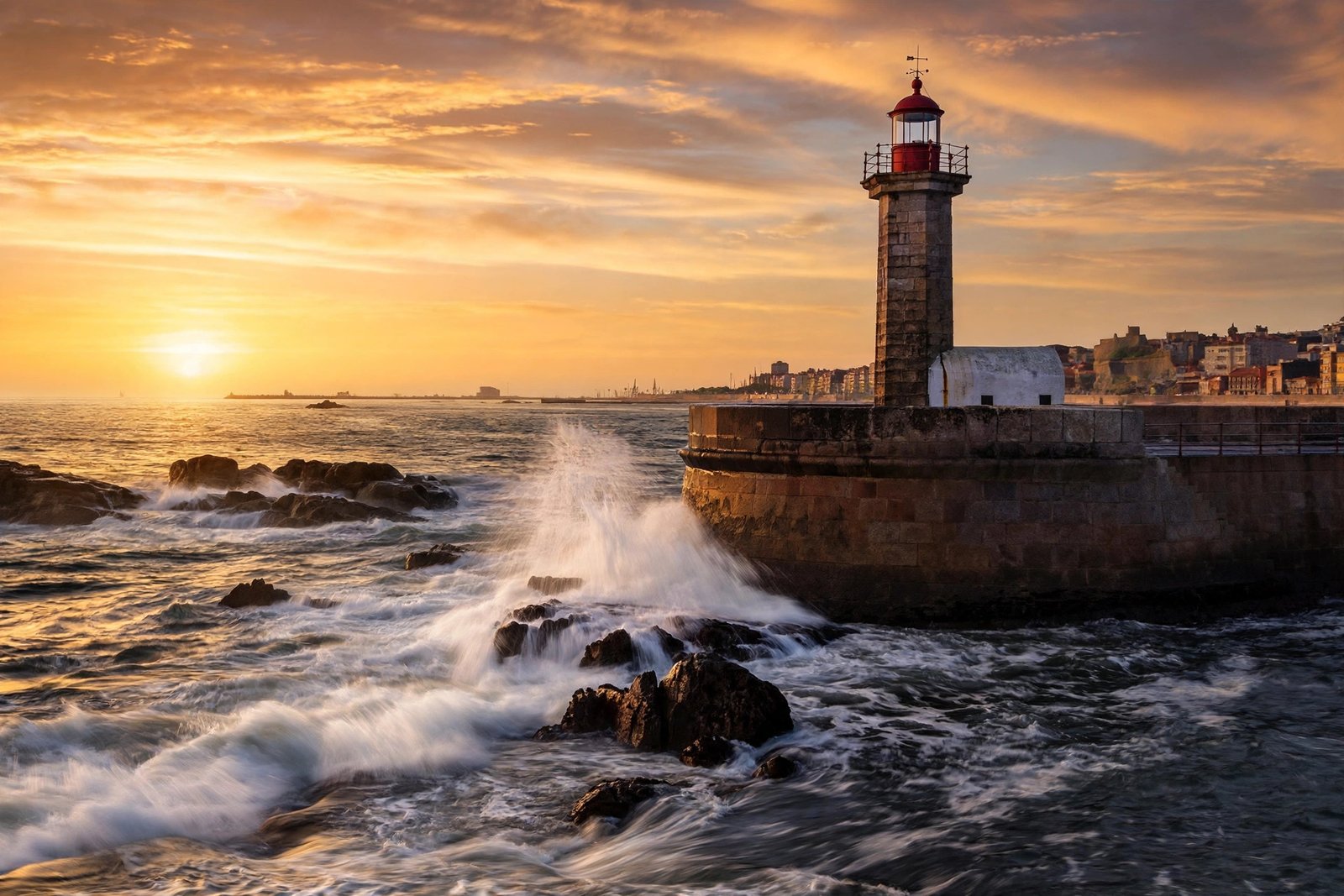
Fourth, generate the still image first and animate it. The Ribeira still is easy to check — if the bridge arch looks wrong, fix the image before spending video credits. Fifth, remember the real details when you caption your video: the upper deck of the Dom Luís I Bridge opened in 1886, São Bento’s tiles were laid between 1905 and 1916, and the Clérigos Tower climb is 240 steps. Correct details make your video useful, not just pretty, and useful videos get saved and shared. And for a different Porto mood entirely, take the tram to Foz do Douro, where the river meets the Atlantic and the lighthouse pier catches the last light of the day.
FAQs — Porto AI Video Prompts
1. Can I use these Porto AI video prompts for commercial projects?
The prompt text is free to use. Whether the generated video can be used commercially depends on your AI tool’s licence — most paid plans allow commercial use, while some free plans require attribution. Check your tool’s terms before selling or monetising the footage.
2. Which AI video tool is best for Porto architecture?
Runway and Kling handle architecture and slow camera moves well, which suits the Ribeira and the bridge. Pika is better for short, punchy social clips. For the most accurate buildings, generate a still image first and use image-to-video mode.
3. How do I avoid distorted faces in Porto AI videos?
Keep people far from the camera and small in the frame, or leave them out entirely. Wide shots of the Ribeira, the river and the bridge look flawless; close-ups of tourists do not. If a scene needs people, describe them as silhouettes or seen from behind.
4. How long should a Porto AI travel video be?
For Reels, Shorts and TikTok, 20 to 40 seconds total works best — four clips of 5 to 8 seconds each. For YouTube, you can extend it with a voiceover and more clips, but keep each individual AI clip short.
5. Can AI video recreate the azulejo tiles of São Bento accurately?
Not perfectly. Detailed tile panels often come out muddled, so describe the hall generally — “blue and white azulejo panels” — instead of naming a specific historical scene. The feeling of the station matters more than pixel-perfect tiles.
6. What is the best time to visit Porto in real life?
May to June and September offer mild weather and thinner crowds, with average highs around 20–24°C. The historic centre is compact but steep — two to three days covers the essentials, plus a day for the Douro Valley if you have it.
Conclusion
Porto is the easiest city in Portugal to make beautiful — the hard part is choosing what to show. These four Porto AI video prompts give you a complete arc: the Ribeira at golden hour to open, the Dom Luís I Bridge at sunset for romance, São Bento station for art, and a Gaia port cellar to close. Generate the stills first, animate them short, cut them to gentle music, and you will have a Porto video that looks like it took a film crew and a week on the Douro. Then pick the next Portuguese city and do it again.
Useful resources: Portugal Tourism — Things to Do in Porto: A Local-Style Planning Guide and Porto Trip — Porto Travel Guide: What to Do, See and Eat (2026).