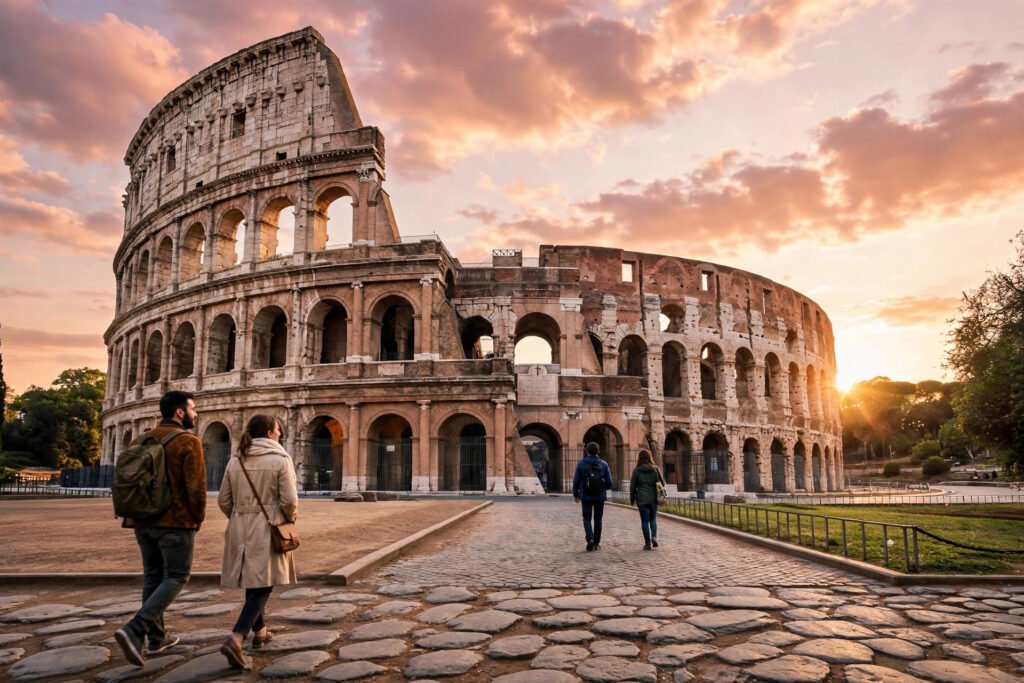
Rome is the only city in the world where you can walk from a gladiator arena built in 80 AD to a Baroque fountain, then to the largest church in Christendom and a forum where emperors once ruled — all before lunch. The Eternal City is an open-air museum, and every street corner is a film set: golden stone, cypress trees, cobblestones worn smooth by two thousand years of footsteps. These Rome AI video prompts turn those real places into ready-to-render travel videos, even if you have never stood under the Colosseum’s arches.
Below you will find four detailed, copy-paste-ready prompts. Each one is built around a real place in Rome — the Colosseum at golden hour, the Trevi Fountain at sunrise, St Peter’s Basilica in the Vatican and the Roman Forum ruins — with camera directions, lighting notes and a matching image idea so your video feels like a real travel film, not a slideshow.
Table of Contents
- 1. The Colosseum at Golden Hour
- 2. The Trevi Fountain at Sunrise
- 3. St Peter’s Basilica and the Vatican
- 4. The Roman Forum Ruins
- Tips for Better Rome AI Video Prompts
- Watch: Rome in Motion
- Frequently Asked Questions
- Conclusion
1. The Colosseum at Golden Hour
The Colosseum is the most visited monument in Europe, and it earns the title. Completed in 80 AD, the Flavian Amphitheatre once held around 50,000 spectators for gladiator fights and wild animal shows, and its broken outer wall — the part that fell in an earthquake — is now its most recognisable feature. At golden hour the travertine stone glows amber, the crowds thin, and the arena looks the way it must have looked to a Roman arriving for the games. Go early or go late; the middle of the day is a wall of tour groups.
Copy-paste prompt:
Cinematic video of the Colosseum in Rome, Italy at golden hour. The ancient stone amphitheatre glows warm amber in the low sun, its arches and broken outer wall catching the evening light, a few visitors walking slowly on the cobblestone street in front, soft pink and orange sky behind. Camera starts wide on the full amphitheatre, then moves slowly forward and tilts up along the arches toward the top rim as the light deepens. Warm, epic, timeless, photorealistic travel film, 4K, no text, no watermark.
Image-prompt idea: A photograph inside the Colosseum, the ancient arena floor and towering stone arches seen from the upper seating level, morning sunlight streaming through the arches onto the sand, a few visitors walking along the upper ring.

Why it works: A single monumental subject with strong symmetry is one of the easiest things for AI video to render well, and golden-hour light hides small texture errors on the ancient stone. The slow forward move with a gentle tilt up is a single camera direction, so the arches stay stable while the sky deepens behind them. Keep the visitors small and in the distance; a crowd in the foreground is where AI faces start to wobble.
Real-world detail worth knowing: the Colosseum opens at 8:30 am year-round, and the first half-hour is golden — arrive with a pre-booked ticket and you walk through security in minutes. A combined ticket covering the Colosseum, Roman Forum and Palatine Hill costs around €18 to €22. The official Colosseum ticketing site has current prices and time slots.
2. The Trevi Fountain at Sunrise
The Trevi Fountain is Baroque excess at its finest — a six-storey marble waterfall designed by Nicola Salvi and completed in 1762, marking the end of the Aqua Virgo aqueduct that has carried water into the city since 19 BC. By midday, ten thousand people squeeze into a plaza the size of a small courtyard. At 6 am, though, the fountain belongs to a handful of early risers, the water glows turquoise in the soft light, and you can actually hear it. That is the hour to film.
Copy-paste prompt:
Cinematic video of the Trevi Fountain in Rome, Italy at sunrise. The grand Baroque marble fountain glows in soft golden morning light, clear turquoise water flowing into the basin, the small plaza almost empty with just a few early visitors, a coin glinting as it arcs into the water. Camera starts wide on the full fountain, then moves slowly forward toward the basin as the water sparkles and the statues catch the light. Soft, magical, peaceful, photorealistic travel film, 4K, no text, no watermark.
Image-prompt idea: A sunrise photograph of the Trevi Fountain, the grand Baroque marble fountain glowing in soft golden morning light, clear turquoise water in the basin and the small plaza almost empty.

Why it works: Water in motion is very forgiving in AI renders — it does not need to be geometrically perfect to look real — and the white marble statues are bold, simple shapes that hold up well. The slow forward move toward the basin gives the clip a natural destination, and the near-empty plaza avoids the crowd problem entirely. Sunrise light also keeps the marble warm instead of washed out.
For more Italian inspiration, see our Venice canals gondola AI video prompts — the same water-and-stone formula works beautifully for Italy’s floating city.
3. St Peter’s Basilica and the Vatican
St Peter’s Basilica is the largest church in the world, built over the tomb of Saint Peter between 1506 and 1626, with Michelangelo’s dome rising over St Peter’s Square. Entry to the basilica itself is free — only the dome climb is paid — and the square, with its colonnade, obelisk and fountains, is one of the grandest public spaces on earth. The best hour is early morning, before the queues form, when the dome catches the first light and the square is almost empty.
Copy-paste prompt:
Cinematic video of St Peter’s Basilica and St Peter’s Square in Vatican City, Rome, in soft morning light. The grand dome rises above the curved colonnade, the wide square with its obelisk and twin fountains stretching out in front, a few visitors walking slowly across the cobblestones. Camera starts wide on the square and the dome, then rises in a slow crane shot toward the dome as the morning light warms the stone. Grand, serene, awe-inspiring, photorealistic travel film, 4K, no text, no watermark.
Image-prompt idea: A photograph of St Peter’s Basilica and St Peter’s Square in Vatican City, the grand dome rising above the colonnade in soft morning light, the wide square with its obelisk and fountains and a few visitors walking across it.

Why it works: The slow crane rise is a single, simple camera move that most video generators handle cleanly, and the dome gives the shot a fixed anchor while the square slides away below. Morning light flatters the pale stone, and the wide empty square hides small imperfections that a busy scene would expose. It is also the most awe-inspiring scene in this set — the natural climax before the ruins.
Planning a wider Italy trip? Our Amalfi Coast AI video prompts cover the mainland coast south of Rome, and our Capri AI video prompts take you to the island in the Bay of Naples.
4. The Roman Forum Ruins
The Roman Forum was the political and social centre of Rome from the 6th century BC until the 5th century AD — the place where senators debated, emperors processed and citizens gathered. Today it is a field of broken columns, crumbling temples and grassy paths, with the Colosseum visible at the end of the Via Sacra and the Palatine Hill rising behind it, where the emperors built their palaces. It is the quietest scene in this set, and the one that makes a Rome video feel like history rather than sightseeing.
Copy-paste prompt:
Cinematic video of the Roman Forum ruins in Rome, Italy in warm late afternoon light. Ancient marble columns and crumbling stone temples among green grass and wildflowers, a stone path leading through the ruins, the Colosseum visible in the distance, cypress trees swaying gently. Camera glides slowly forward along the ancient stone path between the columns as the light turns gold and long shadows stretch across the grass. Peaceful, historic, timeless, photorealistic travel film, 4K, no text, no watermark.
Image-prompt idea: A photograph of the Roman Forum ruins, ancient marble columns and crumbling stone temples among green grass and wildflowers, the Colosseum visible in the distance in warm late afternoon light.

Why it works: A slow forward glide along a straight path is the easiest camera move an AI generator can do well — one direction, one speed, no turns. Broken columns and ruins are also forgiving subjects: irregular stone does not need perfect geometry to look ancient. The Colosseum in the distance ties the final scene back to the opening one, so the four clips feel like one continuous walk through history.
Tips for Better Rome AI Video Prompts
- Let the light tell the time of day. Golden hour for the Colosseum, sunrise for the Trevi Fountain, soft morning for St Peter’s and late afternoon for the Forum — the four prompts above move through a whole day in Rome, and that arc is what makes a four-scene video feel like a real trip.
- One camera move per prompt. Forward move, slow crane, gentle rise or forward glide — pick one. Two moves in one prompt is the most common reason AI videos warp or jump.
- Keep the palette consistent. Warm travertine stone, turquoise water, golden light and green cypress appear in all four prompts above. Repeating those colours across your clips makes a multi-scene video feel like one film.
- Add real sound. Pair the visuals with soft Italian strings or natural ambience — fountain water for the Trevi scene, distant bells for St Peter’s, birdsong and wind for the Forum. The sound sells the age of the place.
- Check your facts. The Colosseum was completed in 80 AD and held around 50,000 spectators; the Trevi Fountain was finished in 1762; St Peter’s Basilica is free to enter and the dome climb is paid; the Forum was Rome’s centre from the 6th century BC. Getting these details right in your video captions builds trust with viewers who have actually been there. Turismo Roma, the city’s official tourism site, confirms opening hours, ticket prices and the best visiting times.
Watch: Rome in Motion
Before you render your own clips, watch how a real travel video frames the city — the Trevi Fountain, the Colosseum, the Pantheon, the Spanish Steps and Vatican City in sequence, by day and by night. It is the best reference for pacing your AI-generated version.
Frequently Asked Questions
What are Rome AI video prompts?
Rome AI video prompts are ready-made text instructions you paste into an AI video generator to create cinematic travel clips of Rome — the Colosseum at golden hour, the Trevi Fountain at sunrise, St Peter’s Basilica and the Roman Forum — without filming there yourself.
Which AI video tools work best with these prompts?
Any modern text-to-video tool that supports cinematic camera moves works well. Tools with a dedicated “cinematic” or “travel film” style preset handle the golden-hour light and the slow crane and glide moves in these prompts most reliably.
How long should each Rome AI video clip be?
Five to ten seconds per clip is ideal. Generate the four scenes separately, then stitch them together in an editor like CapCut with a hard cut and a music track. Short clips also keep columns, domes and fountains from distorting.
Can I use these Rome videos for YouTube Shorts and Instagram Reels?
Yes. Render in vertical 9:16 for Shorts and Reels, or 16:9 for a full YouTube travel video. The prompts above work in either format — just set the aspect ratio in your generator before rendering.
What is the best time of year to show in a Rome video?
April to early June, or September to October — warm but not punishing, crowds manageable, and accommodation prices more reasonable. July and August can hit 35°C and the city gets very crowded.
Do I need tickets for the Colosseum and the Forum?
Yes — one combined ticket covers the Colosseum, Roman Forum and Palatine Hill, and costs around €18 to €22. Book online at least a few days ahead; without a pre-booked slot, expect 90 minutes at the gate. The official Colosseum ticketing site has the latest prices.
Why do my Rome AI videos look warped sometimes?
Usually the prompt asks for too much at once — two camera moves, a crowd, and a complex ruin or dome in the same clip. Simplify to one subject and one slow camera move, and the geometry stays stable.
Conclusion
Rome earns its reputation in about ten seconds of footage: an arena glowing amber at dusk, a marble fountain catching the first light, a dome rising over the grandest square on earth, and a field of broken columns where an empire once ruled. With these four Rome AI video prompts — the Colosseum at golden hour, the Trevi Fountain at sunrise, St Peter’s Basilica and the Roman Forum ruins — you can build a complete travel film that feels like a real walk through two thousand years of history. Render one scene at a time, keep the camera moves slow and simple, and let the city’s own stone do the heavy lifting. Your next viral travel reel might just start with an arena that has stood since 80 AD.
Planning more Italian videos? Our Capri AI video prompts cover the island in the Bay of Naples, and Wikipedia’s Rome page is a solid fact-check for the city’s history, districts and ancient sites.
Pingback: Paris AI Video Prompts: 4 Cinematic Prompts for the City of Light
Pingback: Istanbul AI Video Prompts: 4 Cinematic Prompts for the City of Two Continents
Pingback: Athens AI Video Prompts: 4 Timeless Prompts for the Ancient City
Pingback: Florence AI Video Prompts: 4 Renaissance Prompts for the Cradle of Art